
Belagavi has one of the most layered identities of any city in Karnataka. It sits in the northwestern corner of the state, right on the Maharashtra and Goa borders, in a zone that was contested between Karnataka and Maharashtra as recently as the 2000s under the Mahajan Commission dispute. It is Karnataka’s second administrative capital (winter legislative sessions are held here), home to a major foundry cluster, India’s largest cotton yarn spinning capacity in the region, and Visvesvaraya Technological University. Belagavi Airport — officially still known by its IATA code IXG, derived from the city’s pre-2014 name Belgaum — sits at Sambra, 10 to 14 kilometres east of the city, on a military airfield built in 1942 by the Royal Air Force. The 2017 terminal handles IndiGo and Star Air services to Bengaluru, Delhi, Hyderabad, Ahmedabad, and Jaipur. A ₹223 crore Terminal 2 was 87% complete as of May 2026, targeted for delivery by June 2026. Star Air uses Belagavi as one of its hubs.
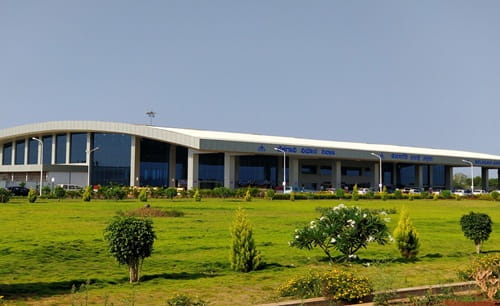
Quick Overview: Belagavi Airport
| Detail | Information |
| Official Name | Belagavi Airport (also: Belgaum Airport / Sambra Airport) |
| Location | Sambra, Belagavi, Karnataka, India |
| Airport Type | Public/Military — Domestic (civil enclave at military airfield) |
| IATA Code | IXG |
| ICAO Code | VOBM |
| Operator | Airports Authority of India (AAI) |
| Hub for | Star Air |
| Opened | 1942 (Royal Air Force WWII airfield) |
| Current Terminal (T1) | Inaugurated 14 September 2017 (3,600 sq. metres) |
| T1 Check-in Counters | 10 |
| T1 Baggage Conveyor Belts | 2 (arrival); 1 (departure) |
| New Terminal (T2) | ₹223 crore; 20,000 sq. metres; capacity 2,400 peak-hour pax; 87% complete as of May 2026 |
| Apron Expansion | Planned 12 aircraft bays; ₹23 crore additional works |
| Runway Length | 2,300 metres × 45 metres |
| Elevation | 758 m / 2,489 ft AMSL |
| Coordinates | 15°51′33″N, 74°37′03″E |
| Distance from City Centre | ~10–14 km east |
| Passengers (Jan 2024–Mar 2025) | 4,29,755 |
| Aircraft Movements (Jan 2024–Mar 2025) | 6,789 |
| Current Airlines | IndiGo, Star Air |
| Active Routes | Bengaluru, Delhi, Hyderabad (IndiGo); Ahmedabad, Jaipur and others (Star Air) |
Belagavi Airport Location: Sambra on the Karnataka–Maharashtra Border Zone
Belagavi Airport is located at Sambra village, approximately 10 to 14 kilometres east of Belagavi city centre. The coordinates are 15°51′33″N, 74°37′03″E, at an elevation of 758 metres above mean sea level — one of the higher-altitude airports in peninsular India, reflecting Belagavi’s position on the Deccan Plateau where the Karnataka tableland abuts the Western Ghats escarpment.
The airport’s access from the city is via the Bagalkote-Belagavi Road. City buses connect the airport to the central bus stand and key city areas. The proposed four-lane road to Sambra Airport — discussed at the Belagavi Aerodrome Advisory Committee meeting in May 2026 — would significantly reduce congestion on the current route. Discussions with PWD engineers were to be expedited following the advisory committee’s review.
Belagavi’s border position is commercially relevant. The airport catchment is not limited to Belagavi district but extends into Sangli and Kolhapur (Maharashtra) to the north and Goa’s Dharwad-adjacent districts to the southwest. Residents of southern Maharashtra who lack convenient air access to Pune or Mumbai’s airports sometimes use Belagavi as an alternative. Goa’s airports at Dabolim (GOI, approximately 135 km) and Mopa (GOX, approximately 135 km) serve as international alternatives for Belagavi residents with international travel needs.
Belagavi Airport Code: IATA IXG and ICAO VOBM
The airport’s IATA code is IXG and its ICAO code is VOBM. IXG derives from the city’s pre-2014 name Belgaum — the IATA code was assigned when the city was still officially named Belgaum and has not changed following the 2014 renaming to Belagavi. VOBM places it in the VO southern India block. Booking for Belagavi flights should use IXG; the city appears under both “Belagavi” and “Belgaum” on airline platforms. The airport is also commonly referred to as Sambra Airport after the village where it is located.
Belagavi Airport Terminal: 2017 Terminal With Major T2 Under Construction
Terminal 1 (Current): The existing integrated terminal was inaugurated on 14 September 2017 by the then Minister of Civil Aviation, Ashok Gajapathi Raju, alongside a runway extension to 2,300 metres. The 2017 milestone was a transformational event for Belagavi aviation — the extended runway allowed Airbus A320 class narrow-body jets to operate, ending the era when only smaller turboprop aircraft could use the airport. The terminal covers 3,600 square metres and has 10 check-in counters, two baggage conveyor belts in the arrival hall, one in the departure hall, a security hold area with approximately 600 square metres of waiting lounge, and separate arrival and departure halls each covering around 400 square metres.
The airport’s history stretches from its 1942 Royal Air Force construction through the immediate post-independence period when Indian Airlines commenced operations, through a 1989–2011 phase as primarily a training base, and into the UDAN-era commercial revival. Star Air uses Belagavi as one of its hub bases, giving the airport its most consistent multi-destination network.
Terminal 2 (Under Construction): The foundation stone for Terminal 2 was laid by PM Modi in March 2024, and construction commenced immediately. The new terminal is being built at a cost of ₹223 crore, covering 20,000 square metres — more than five times the current terminal’s footprint. T2 is designed to handle 2,400 peak-hour passengers, split equally between arrivals and departures (1,200 each). As of May 2026, construction was approximately 87% complete, with a target delivery date of June 2026. Parallel apron expansion and new taxilink works are underway at an additional ₹23 crore, targeting 12 aircraft parking bays total. The IAF land transfer of 15 to 16 acres (required for a parallel taxiway to meet DGCA safety norms) was under discussion with Air Force authorities through the advisory committee as of May 2026.
Belagavi Airport Connectivity: IndiGo and Star Air to Six Destinations
By Air: IndiGo and Star Air are the two scheduled carriers at Belagavi Airport as of mid-2026. IndiGo connects Belagavi to Bengaluru, Delhi, and Hyderabad, with additional flights to Mumbai and Hyderabad added under the 2025 winter schedule. Star Air serves Ahmedabad, Jaipur, and other Star Air network destinations. MP Jagadish Shettar, chairing the Aerodrome Advisory Committee in May 2026, urged both IndiGo and Star Air to introduce new routes to Pune, Chennai, Ahmedabad, and Jodhpur — suggesting the network is expected to expand. Confirm current schedules before booking as seasonal adjustments apply.
By Road: The airport is approximately 10 to 14 km east of Belagavi city centre via the Bagalkote-Belagavi Road. State-run city buses connect the airport to the central bus stand and other parts of the city. Taxis and auto-rickshaws are available from the terminal. A four-lane road project connecting the city to the airport is in discussion, aimed at reducing congestion on the current two-lane approach.
By Rail: Belagavi Railway Station is the city’s main rail junction, connected to Bengaluru via the Londa–Hubli route. A Vande Bharat Express linking Belagavi to KSR Bengaluru City was launched on 10 August 2025 (inaugural) and 11 August 2025 (commercial), running six days a week over approximately 8 hours 10 minutes — a significant improvement in Bengaluru connectivity for Belagavi’s large business and professional population. The station is approximately 13 to 15 km from the airport.
Belagavi Airport Amenities: T1 Facilities; T2 to Transform by Late 2026
The existing Terminal 1 provides the standard domestic airport amenity set: check-in counters, security screening, a departure lounge with seating, air conditioning, food and beverage counters, and baggage claim. Wheelchair access is available. Car rental desks and pre-paid taxi counters operate in the arrivals area. Wi-Fi is available. The terminal is compact but functional, and the addition of T2 by late 2026 will dramatically expand space for commercial retail, food courts, lounges, and passenger comfort.
The T2 project’s 2,400 peak-hour capacity represents roughly a five-fold increase over T1’s current throughput ceiling, future-proofing Belagavi’s aviation infrastructure for the growth trajectory the airport’s location, Star Air hub status, and expanding route network suggest.
FAQs: Belagavi Airport
Q1. What is the IATA code for Belagavi Airport?
The IATA code is IXG and the ICAO code is VOBM. The code IXG derives from the city’s former name Belgaum. The airport is also known as Sambra Airport. Book using IXG or search “Belagavi” or “Belgaum” on airline platforms.
Q2. Which airlines fly from Belagavi Airport?
IndiGo (Bengaluru, Delhi, Hyderabad, Mumbai) and Star Air (Ahmedabad, Jaipur, and other Star Air network cities) operate from Belagavi as of mid-2026. Confirm current schedules before booking.
Q3. When will Terminal 2 at Belagavi Airport be ready?
Terminal 2 — costing ₹223 crore, covering 20,000 square metres, with 2,400 peak-hour passenger capacity — was 87% complete as of May 2026, with a target completion date of June 2026. It will dramatically expand Belagavi Airport’s capacity and commercial amenities.
Q4. What is the runway length at Belagavi Airport?
The runway is 2,300 metres long, capable of handling Airbus A320 and Boeing 737 class narrow-body jet aircraft. It was extended to this length as part of the 2017 terminal inauguration works.
Q5. Is Belagavi Airport a military base?
Yes. The airport is a civil enclave on a military airfield that has existed since 1942 when it was built by the Royal Air Force during WWII. AAI manages the civilian enclave while the military retains the base. Land transfers from the Air Force for taxiway safety improvements are ongoing as of mid-2026.


