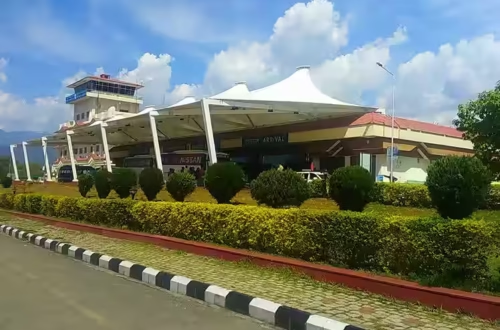
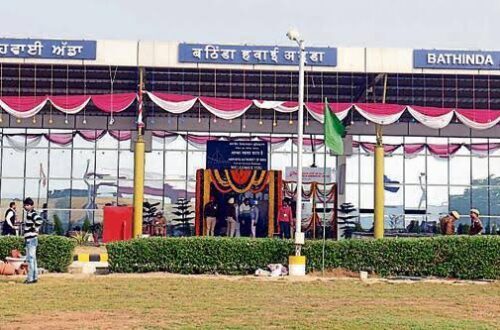
North Andhra Pradesh has been waiting a long time for an airport it can call its own — one not hemmed in by a naval airbase boundary or limited by Cold War-era infrastructure. That wait is ending. The Alluri Sitarama Raju International Airport at Bhogapuram, the largest greenfield airport project currently being delivered in South India, received its first validation flight on January 4, 2026, and commercial operations are scheduled to begin from the first week of July 2026. Named after the legendary tribal revolutionary who led the Rampa Rebellion against British colonial rule in the 1920s, this airport carries both modern ambition and deep regional identity.

Quick Overview: Alluri Sitarama Raju International Airport
| Detail | Information |
| Official Name | Alluri Sitarama Raju International Airport |
| Also Known As | Bhogapuram Airport |
| Location | Bhogapuram, Vizianagaram District, Andhra Pradesh |
| Airport Type | Public — International (Greenfield) |
| IATA Code | VOX (reported; confirm with AAI/DGCA before travel) |
| ICAO Code | VOVI (reported; confirm with AAI/DGCA before travel) |
| Owner | Government of Andhra Pradesh |
| Operator | GMR Visakhapatnam International Airport Limited (GVIAL) |
| Total Land Area | 2,203 acres |
| Phase 1 Cost | ₹4,725 crore |
| Runway Length | 3,800 metres |
| Phase 1 Annual Capacity | 6 million passengers |
| Distance from Visakhapatnam | ~44–45 km |
| Distance from Vizianagaram | ~23 km |
| First Validation Flight | January 4, 2026 |
| Commercial Operations Target | July 2026 |
Alluri Sitarama Raju Airport Location: Bhogapuram Between Vizag and Vizianagaram
The airport sits at Bhogapuram in Vizianagaram district, off National Highway 16 — the main coastal highway linking Kolkata and Chennai through Andhra Pradesh. It is approximately 44 to 45 kilometres northeast of Visakhapatnam, 23 kilometres from Vizianagaram city, and about 64 kilometres from Srikakulam. This triangular positioning in the North Andhra geography is deliberate — the airport is designed to serve not just Visakhapatnam but the entire cluster of north coastal Andhra districts and parts of southern Odisha, a combined catchment that has historically had limited aviation access.
The site itself spans 2,203 acres — a footprint that immediately signals the scale difference from the cramped naval enclave that currently serves Vizag. Elevation is a modest 59 feet above mean sea level, and the flat coastal terrain at Bhogapuram offered engineering advantages that inland hillier locations would not have.
Alluri Sitarama Raju Airport Code: IATA and ICAO Details
The airport has been reported under the IATA code VOX and ICAO code VOVI. Since the airport was in final pre-commissioning stages as of mid-2026 and formal codes are assigned close to operational launch, travellers should verify the current active codes directly with AAI, DGCA, or airline booking platforms before ticketing. IATA and ICAO codes for new airports are sometimes updated or confirmed only at the point of first scheduled commercial service.
Alluri Sitarama Raju Airport Terminal: Scale, Design and Capacity
The passenger terminal building at Bhogapuram is the centrepiece of a ₹4,725 crore Phase 1 investment developed by GMR Airports Infrastructure under a public-private partnership with the Andhra Pradesh government. As of June 2026, the terminal was 98.76% complete, with the Air Traffic Control tower at 95.75% completion.
Phase 1 is designed to handle 6 million passengers annually, with expansion potential to 12 million in Phase 2 and ultimately 18 million. The terminal is engineered to international standards — built to accommodate wide-body aircraft including the Boeing 747-8 and Airbus A380. The 3,800-metre runway, which accommodated an Air India Airbus A320 on the validation flight in January 2026, is the longest runway in the country, designed to handle large international long-haul aircraft with the necessary safety margins.
The airport has been designed to withstand severe cyclones, capable of resisting wind speeds up to 275 km per hour without structural damage — an important engineering consideration for a coastal Andhra facility. A drainage system rated to handle 27 cm of rainfall has also been built in. Cargo infrastructure is included in Phase 1, with the airport expected to facilitate the export of 20,000 tonnes of cargo annually once operations stabilise.
An EduCity — a national aviation training and education hub — is also planned as part of the broader airport campus, aimed at producing aviation professionals for India and global markets.
Alluri Sitarama Raju Airport Connectivity: Road, Rail and Regional Access
By Road: National Highway 16 provides the primary road access to the airport. Seven connecting roads from Visakhapatnam were initiated in September 2025 and targeted for completion by the time of the airport opening in mid-2026. APSRTC plans to operate connecting bus services to Visakhapatnam, Vizianagaram, and other nearby cities.
Long-term connectivity plans include a potential elevated corridor linking the airport to Visakhapatnam. A Vizag beach corridor and integration with a future Vizag Metro are also in discussion for eventual multi-modal connectivity, though these are medium-to-long-term projects beyond the 2026 launch horizon.
By Rail: Vizianagaram Junction is the nearest railway station at approximately 26 kilometres from the airport. It is a well-connected station on the Howrah–Chennai main line, giving travellers from Vizianagaram and surrounding areas a practical rail-then-road connection to the new airport.
Airlines and Routes: At the time of writing, Air India has been involved in validation flights. Commercial airline route announcements were expected around the July 2026 launch window. Given the airport’s scale and its role as the eventual replacement for Visakhapatnam Airport, domestic routes to major metros and select international destinations to the Middle East and Southeast Asia are anticipated in the early operational period.
Alluri Sitarama Raju Airport Amenities: What the New Terminal Offers
As a freshly constructed international airport developed under a PPP model by GMR — the same group that operates Hyderabad’s Rajiv Gandhi International Airport and Delhi’s Indira Gandhi International Airport — the amenity profile at Bhogapuram is expected to be well above the regional airport average.
The terminal will include modern check-in counters, multiple security lanes, international-grade immigration and customs processing, aerobridges for direct boarding, cargo handling facilities, retail and food and beverage outlets, passenger lounges, and accessible infrastructure for differently-abled travellers. Specific amenity details, operator names, and retail brands were being finalised in the pre-launch phase. Travellers should check the airport’s official GMR or AAI communications for the confirmed amenity list once commercial operations commence.
FAQs: Alluri Sitarama Raju International Airport
Q1. What is the official name and location of Bhogapuram Airport?
A: The official name is Alluri Sitarama Raju International Airport. It is located at Bhogapuram in Vizianagaram district, approximately 44 km from Visakhapatnam.
Q2. When will commercial flights start from this airport?
A: Commercial operations are scheduled to begin from the first week of July 2026. PM Modi was expected to inaugurate the facility around July 5, 2026, subject to availability. Confirm the latest schedule with airlines before booking.
Q3. How long is the runway at Bhogapuram Airport?
A: The runway is 3,800 metres — the longest in the country — capable of handling wide-body aircraft including the Boeing 747 and Airbus A380.
Q4. Who operates Alluri Sitarama Raju International Airport?
A: It is operated by GMR Visakhapatnam International Airport Limited (GVIAL), a subsidiary of GMR Group, under a public-private partnership with the Andhra Pradesh government.
Q5. What is the passenger capacity of the new airport?
A: Phase 1 is designed to handle 6 million passengers annually, expandable to 12 million in Phase 2 and up to 18 million in the long term.