Bhuj is a city with a layered story — ancient capital of the Kutch princely state, epicentre of the devastating 2001 Gujarat earthquake, and since then, a city that has rebuilt itself into a remarkable model of post-disaster reconstruction. The Rann of Kutch — the vast salt marshes stretching north toward Pakistan — draws hundreds of thousands of visitors annually, peaking dramatically during the Rann Utsav festival between November and February. Bhuj Airport is both the civilian air gateway to all of this and one of the more historically resonant airports in India. During the 1971 Indo-Pakistani War, its runway was bombed and destroyed — and rebuilt in just 72 hours by over 300 local women using basic tools, enabling the resumption of critical IAF operations. That story, documented and celebrated, is part of what makes Bhuj Airport something beyond an ordinary regional facility.
Quick Overview: Bhuj Airport
| Detail | Information |
| Official Name | Bhuj Airport (also known as Rudra Mata Airport) |
| Location | Bhuj, Kutch District, Gujarat |
| Airport Type | Military/Public — Domestic (Civil Enclave at Rudra Mata Air Force Station) |
| IATA Code | BHJ |
| ICAO Code | VABJ |
| Operator | Indian Air Force and Airports Authority of India (AAI) |
| Current Terminal Built | 2003 (post-earthquake reconstruction) |
| Terminal Area | ~7,710 sq. metres |
| Terminal Capacity | ~350–400 passengers |
| Runway Length | ~8,250 ft (approx. 2,515 metres) |
| Elevation | 257 ft / 78 m AMSL |
| Distance from City | ~3–5 km |
| Passengers (2024–25) | 1,86,403 (94.6% increase YoY) |
| Current Airlines | IndiGo, Air India |
| Active Routes | Mumbai, Ahmedabad (primary) |
Bhuj Airport Location: Kutch District’s Civil Enclave
Bhuj Airport is located in Bhuj, the headquarters of Kutch district, approximately 3 to 5 kilometres from the city centre. The coordinates are 23°17′16″N, 69°40′13″E, at an elevation of 257 feet above mean sea level. The airport is officially a civil enclave operating within the Rudra Mata Air Force Station — sharing its runway with IAF operations, a structural arrangement that gives it both strategic military depth and civilian utility.
Kutch district is India’s largest district by area and among the most dramatically diverse — from the salt flats of the Great Rann and Little Rann to the Banni grasslands, the Kala Dungar (Black Hill), the coastal town of Mandvi, and the historic crafts of the Kutchi tribal communities. The airport serves all of these tourism streams simultaneously. Rann Utsav, the annual winter cultural festival at Dhordo, draws over 7 lakh visitors and causes a sharp seasonal spike in flight demand between November and February — the period during which BHJ flight fares can double or triple.
Bhuj Airport Code: IATA BHJ and ICAO VABJ
The airport’s IATA code is BHJ and its ICAO code is VABJ. BHJ is used across all airline booking platforms, boarding passes, and baggage systems for Bhuj. The airport is also known as Rudra Mata Airport in some references, derived from the air force station name. VABJ places it in the VA western India block, appropriate for Gujarat’s westernmost commercial airport.
Bhuj Airport Terminal: Earthquake-Resistant Design from 2003 Reconstruction
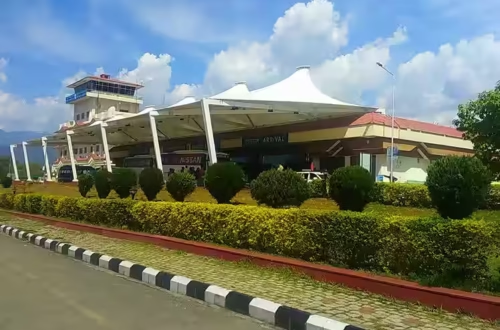
The current terminal at Bhuj Airport was inaugurated in 2003, built at a cost of ₹19.51 crore by AAI as part of the post-2001 earthquake reconstruction effort. The 2001 Gujarat earthquake caused massive destruction across Kutch, and the previous airport infrastructure was substantially damaged. The new terminal was designed to be earthquake-resistant, a requirement that shaped both its structural engineering and its symbolic importance for the city’s rebuilding narrative.
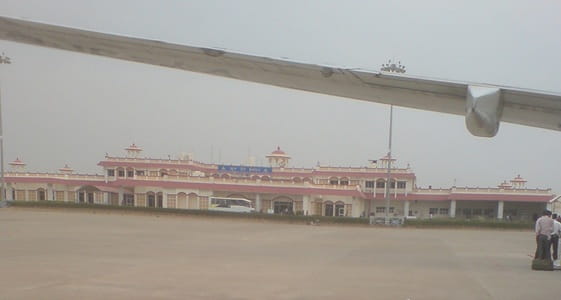
The terminal covers 7,710 square metres and can handle approximately 350 to 400 passengers at peak hours. It operates a single building handling both arrivals and departures. The layout is compact but well-organised — check-in counters, security screening, a departure lounge, and baggage claim all within close proximity. Jet Airways launched the first scheduled domestic service from the new terminal at 8:00 am shortly after the building opened, marking the airport’s formal entry into regular civilian scheduled aviation.
The runway at approximately 8,250 feet (2,515 metres) is capable of accommodating Airbus A320 and Boeing 737 class narrow-body aircraft — a significant operational capacity for a regional civil enclave of Bhuj’s scale. This runway length means major low-cost carriers can operate jet services directly here without the ATR-only limitation that constrains smaller Gujarat airports.
Bhuj Airport Connectivity: IndiGo and Air India to Mumbai and Ahmedabad
By Air: IndiGo and Air India are the primary scheduled commercial carriers at Bhuj Airport. The main routes connect Bhuj to Mumbai and Ahmedabad — both served regularly throughout the year with increased frequency during the Rann Utsav season. Passenger traffic grew dramatically in 2024–25, reaching 1,86,403 — a 94.6% increase year-on-year, reflecting the sharp post-COVID recovery and growing Rann of Kutch tourism momentum. Current routes and frequencies should be confirmed on airline booking platforms before travel, as schedules are updated seasonally.
Booking Advice for Rann Utsav: During the November to February Rann Utsav festival season, BHJ flights can become fully booked weeks in advance and fares can double or triple from baseline levels. Booking 45 to 60 days in advance is strongly advisable for Kutch visitors during this window.
By Road: GSRTC buses connect Bhuj city bus stand to the airport at ₹10 to ₹30. Taxis and auto-rickshaws are available from the terminal exit. Travel time to Bhuj city centre is approximately 15 to 20 minutes. Dhordo and the Rann Utsav tent city are approximately 80 to 90 km from the airport — around 1.5 to 2 hours by road.
By Rail: Bhuj Railway Station is connected to the broad-gauge network via Gandhidham, giving access to Ahmedabad, Mumbai, and the broader Indian rail network. The station is approximately 4 to 5 km from the airport.
Nearest Alternative Airport: Kandla Airport (IXY, near Gandhidham) is approximately 80 km east and serves as an alternative aviation entry for eastern Kutch visitors.
Bhuj Airport Amenities: Compact but Practical at a Tourism Gateway
Bhuj Airport’s terminal provides the essential services appropriate for a regional civil enclave handling under 2 lakh annual passengers. There are food and snack counters within the terminal — basic options rather than a food court. Small shops carry essential items for travellers. Check-in counters serve IndiGo and Air India operations. Wheelchair assistance is available. Signage is clear given the terminal’s single-building, single-floor layout.
There are no commercial passenger lounges, no duty-free retail, and no premium dining outlets. Hotels in multiple categories are available near the airport, with some mid-to-premium properties offering airport pickup services for pre-booked guests — worth arranging in advance, particularly during the Rann Utsav season when local transport options become stretched.
Security at Bhuj operates within the military airbase context, meaning passengers should arrive at least 90 minutes before departure to account for the additional security checks associated with a joint civil-military facility. During peak Rann Utsav season, the terminal’s single security lane can create queues — factoring in extra arrival time is advisable.
FAQs: Bhuj Airport
Q1. What is the IATA code for Bhuj Airport?
A: The IATA code is BHJ and the ICAO code is VABJ. The airport is also known as Rudra Mata Airport, reflecting the adjacent IAF station name.
Q2. Which airlines operate from Bhuj Airport?
A: IndiGo and Air India operate scheduled domestic flights from Bhuj, primarily to Mumbai and Ahmedabad. Routes and frequencies should be confirmed on airline platforms before booking.
Q3. When should I book flights to Bhuj for Rann Utsav?
A: Book 45 to 60 days in advance for Rann Utsav season (November to February). Flights can be fully booked weeks before departure and fares can double or triple during this peak tourism window.
Q4. What is the historical significance of Bhuj Airport?
A: During the 1971 Indo-Pakistani War, the runway was bombed by Pakistani aircraft. Over 300 local women from surrounding villages rebuilt it using basic tools in just 72 hours, enabling the resumption of IAF operations — a story of civilian contribution to national defence that has become part of Bhuj’s identity.
Q5. How far is Bhuj Airport from the Rann of Kutch?
A: The White Rann and the Rann Utsav tent city at Dhordo are approximately 80 to 90 km from Bhuj Airport, around 1.5 to 2 hours by road. Permit entry at Dhordo must be arranged in advance through Gujarat Tourism.