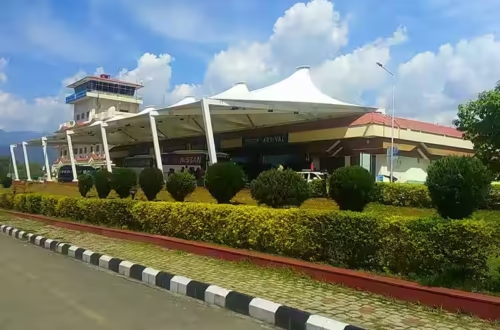
Bihar’s most internationally recognised airport sits not in the state capital but in Gaya — a city whose fame rests entirely on what happened under a Bodhi tree approximately 2,600 years ago. Bodh Gaya, just 5 kilometres from the airport, is where Siddhartha Gautama attained enlightenment, making it the holiest site in Buddhism and one of the four sacred Buddhist pilgrimage destinations globally. Gaya International Airport exists to serve that pilgrimage flow. Thai, Bhutanese, Myanmarese, Japanese, Sri Lankan, Cambodian, Laotian, and Vietnamese Buddhist delegations, tour operators, and individual devotees have for years flown directly into Gaya during the pilgrimage season — a pattern that gives this modest 954-acre airport a distinctly international character that few airports of its physical scale in India can claim.
Quick Overview: Gaya Airport
| Detail | Information |
| Official Name | Gaya International Airport |
| Also Known As | Bodh Gaya Airport |
| Location | Gaya, Bihar, India |
| Airport Type | Public — International |
| IATA Code | GAY |
| ICAO Code | VEGY |
| Operator | Airports Authority of India (AAI) |
| Opened | 2002 (international operations from early 2010s) |
| Total Land Area | 954 acres |
| Terminal Area | ~7,500 sq. metres |
| Terminal Capacity | ~500 passengers |
| Runway Length | Accommodates Airbus A320 class |
| Elevation | 116 m / 380 ft AMSL |
| Distance from Gaya City | ~5–9 km |
| Distance from Bodh Gaya | ~5 km |
| Passengers (2024–25) | 3,29,304 |
| Current Domestic Airlines | IndiGo, SpiceJet, Air India |
| International Operations | Seasonal pilgrimage charters from Thailand, Myanmar, Bhutan, Sri Lanka, Japan and others |
Gaya Airport Location: Gateway to the Buddhist Sacred Circuit
Gaya Airport is located within Gaya city, Bihar, approximately 5 to 9 kilometres from the city centre depending on the measurement point, and critically, just 5 kilometres from the temple town of Bodh Gaya. The coordinates are 24°44′40″N, 84°57′04″E, and the airport sits at an elevation of 116 metres above mean sea level. The airport is roughly 100 kilometres south of Patna, Bihar’s capital.
The positioning of this airport relative to Bodh Gaya is its defining geographic fact. Bodh Gaya’s Mahabodhi Temple Complex is a UNESCO World Heritage Site, and the surrounding area hosts dozens of national monasteries built by Buddhist countries — the Thai Monastery, the Bhutanese Monastery, the Japanese Temple, the Chinese Temple, and many others. The airport serves as the most direct aerial entry into this sacred cluster. A traveller from Bangkok, Colombo, or Mandalay can fly directly into GAY during the pilgrimage season and reach the Mahabodhi Temple in 15 to 20 minutes.
Beyond Buddhism, Gaya is also a significant Hindu pilgrimage destination. The Vishnupad Temple on the Falgu river draws Hindu pilgrims performing Pitru Paksha rites, and the airport handles those surges as well. SpiceJet operated Hajj services from Gaya in 2025, transporting approximately 15,500 Muslim pilgrims to Jeddah — a 18% increase from 2024 — reflecting the airport’s multi-faith pilgrimage profile that is unusual in Indian aviation.
Gaya Airport Code: IATA GAY and ICAO VEGY — and the Controversy
The airport’s IATA code is GAY and its ICAO code is VEGY. GAY follows the standard phonetic abbreviation convention from the city name. However, the code has been the subject of parliamentary debate: in 2021, the Parliamentary Committee on Public Undertakings recommended changing it to YAG, arguing the existing code was “inappropriate, unsuitable, offensive and embarrassing” given the slang connotation of the word in contemporary English. IATA rejected the request in February 2022, maintaining that codes are permanent unless a compelling aviation safety justification exists. The code remains GAY across all booking systems and boarding passes, and the matter has not progressed further since.
Gaya Airport Terminal: Single Integrated Building for Domestic and International
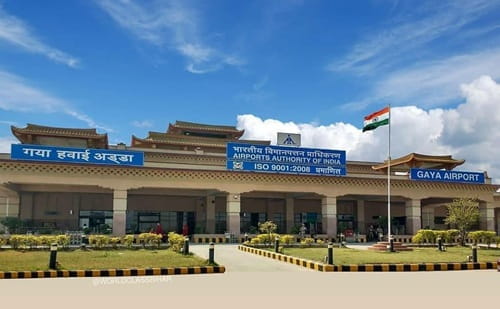
Gaya Airport operates from a single integrated terminal — Terminal 1 — that handles both domestic and international passengers within the same building. The terminal spans approximately 7,500 square metres and has a capacity of around 500 passengers, with the apron capable of accommodating five Airbus A320-class aircraft simultaneously.
The terminal houses check-in counters on the ground floor, security screening, a departure lounge, and customs and immigration facilities for international arrivals. Self-check-in kiosks are available. The Air India counter is on the ground floor of Terminal 1. A passenger lounge is available for eligible travellers. Baggage claim is in the arrival section. The terminal is compact but purposefully equipped for international operations, with customs and immigration staffed during scheduled international pilgrimage flight seasons.
The terminal has plans for expansion: runway extension on an additional 100 acres of land has been discussed, along with broader capacity improvements to handle the growing pilgrimage traffic demand. As of mid-2026, these remain at planning and approval stages rather than active construction.
Gaya Airport Connectivity: Domestic Routes and International Buddhist Circuit
By Air (Domestic): IndiGo operates daily connections from Gaya to Kolkata and Varanasi. Air India launched daily Gaya–Delhi service from 1 September 2025, operated with Airbus A320 aircraft — timed to facilitate convenient one-stop connections for Buddhist pilgrims arriving from Southeast and East Asian cities via Delhi. SpiceJet also operates domestic routes. Airlines and routes should be confirmed before booking as schedules may change.
By Air (International): Gaya International Airport handles seasonal direct pilgrimage flights from Thailand, Myanmar, Bhutan, Sri Lanka, Japan, Vietnam, Cambodia, and Laos. Bangkok–Gaya direct flights resumed in October 2024 with 118 tourists and devotees on the inaugural service. These international flights operate primarily from October to March, aligned with the Buddhist pilgrimage season when weather in Bodh Gaya is most favourable. Outside that window, international connectivity is thin and pilgrims typically route through Delhi or Kolkata.
By Road: Private taxis and app-based cabs including Uber are available from Gaya Airport. Travel to Gaya city centre takes 5 to 10 minutes; to Bodh Gaya, approximately 15 to 20 minutes. E-rickshaws and auto-rickshaws are available for short-distance trips between the airport and Bodh Gaya.
By Rail: Gaya Junction is a significant railway station on the Grand Chord route, connecting to Delhi, Kolkata, Mumbai, Varanasi, and other major cities. The station is approximately 7 to 9 kilometres from the airport, easily reached by taxi.
Gaya Airport Amenities: Pilgrimage-Oriented Services in a Compact Terminal
Gaya Airport’s amenity profile is shaped entirely by its dual domestic-pilgrimage identity. The terminal has cafes and restaurants where passengers can eat before or after flights. Shopping options include souvenir shops reflecting both Buddhist and Hindu pilgrimage themes — relevant for an airport used heavily by international Buddhist visitors. Basic waiting areas with seating are available. Restroom facilities are maintained on-site. Wheelchair assistance is available for those needing it.
Parking facilities exist for both short-term and long-term vehicle use. Business centres are also noted within the airport complex. There is no premium commercial lounge on the scale of a major hub airport, but the lounge facility noted by Air India serves eligible passengers.
The customs and immigration infrastructure — staffed during international flight seasons — is a key operational feature that distinguishes this airport from purely domestic regional airports. During peak Buddhist season, the arrival hall handles delegations from multiple countries simultaneously, requiring customs officers, health officials, and ground handlers to coordinate international-standard processing in a relatively compact space.
FAQs: Gaya Airport
Q1. What is the IATA code for Gaya Airport?
The IATA code is GAY and the ICAO code is VEGY. The code GAY has been the subject of parliamentary controversy, but IATA rejected a change request in February 2022 and the code remains in use.
Q2. Is Gaya Airport an international airport?
Yes. It operates seasonal direct international pilgrimage flights from Thailand, Myanmar, Bhutan, Sri Lanka, Japan, and other Buddhist-majority countries. Customs and immigration facilities are in place.
Q3. Which domestic airlines fly from Gaya Airport?
IndiGo, SpiceJet, and Air India operate domestic routes. IndiGo connects Gaya to Kolkata and Varanasi. Air India launched daily Delhi service from September 2025. Check current schedules before booking.
Q4. How close is Gaya Airport to Bodh Gaya?
The airport is approximately 5 kilometres from Bodh Gaya, with a road travel time of 15 to 20 minutes by taxi — the most direct aviation gateway to the site where the Buddha attained enlightenment.
Q5. When do international flights operate from Gaya Airport?
International pilgrimage flights primarily operate between October and March, aligned with the Buddhist pilgrimage season. Outside this window, international connectivity is limited, with most overseas visitors routing through Delhi or Kolkata.