Jaipur wears its identity on its walls — the Pink City, its old walled quarter painted a shade of terracotta-salmon that Maharaja Ram Singh II ordered applied in 1876 to welcome the Prince of Wales. The Amber Fort, Hawa Mahal, City Palace, Jantar Mantar observatory, and the bazaars of Johri, Bapu, and Tripolia — this is the city that anchors Rajasthan’s Golden Triangle alongside Agra and Delhi. It is also a rapidly growing metropolis of over 4 million, the state capital with a significant IT sector in Sitapura and Malviya Nagar, a gem and jewellery export hub, and the administrative centre of India’s largest state by area. Jaipur International Airport — at Sanganer, 13 kilometres south of the city — carries IATA code JAI and ICAO code VIJP, handled 60,57,249 passengers in 2024–25, and is operated by Adani Airports under a 50-year concession. A new Terminal 2 in Rajasthani architectural style, two international routes to Dubai and Bangkok, and a non-stop IndiGo focus city network of over 30 domestic destinations make JAI Rajasthan’s primary aviation gateway.
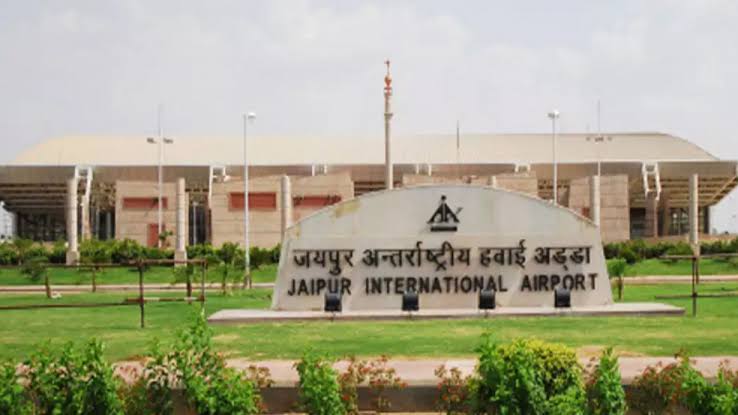
Quick Overview: Jaipur International Airport
| Detail | Information |
| Official Name | Jaipur International Airport |
| Also Known As | Sanganer Airport |
| Location | Sanganer, Jaipur, Rajasthan, India |
| Airport Type | Public — International |
| IATA Code | JAI |
| ICAO Code | VIJP |
| Owner | Airports Authority of India (AAI) |
| Operator | Jaipur International Airport Limited (JIAL) — Adani Group |
| Concession | 50-year concession (Adani) |
| Focus City for | Air India Express, IndiGo |
| Terminal 1 (T1) | 10,000–18,000 sq. metres (upgraded 2018–24; Rajasthani architecture) |
| Terminal 2 (T2) | 22,950 sq. metres; 14 check-in counters; 4 security counters |
| Runways | 2 (09/27 and 09R/27L) |
| Elevation | 385 m / 1,263 ft AMSL |
| Coordinates | 26°49′27″N, 75°48′44″E |
| Distance from City Centre | ~13 km south (from Hawa Mahal area) |
| Distance from Amber Fort | ~24 km |
| Passengers (2024–25) | 60,57,249 (+10.8% YoY) |
| Aircraft Movements (2024–25) | 48,407 (+7.9% YoY) |
| Cargo Tonnage (2024–25) | 21,761 tonnes (+12.1% YoY) |
| Current Airlines | IndiGo, Air India, Air India Express, SpiceJet, Akasa Air |
| International Routes | Dubai (IndiGo), Bangkok (IndiGo), Kuwait (Air Arabia) |
Jaipur Airport Location: Sanganer’s Craft Township Turned Aviation Hub
Jaipur International Airport is located in Sanganer, approximately 13 kilometres south of Jaipur city centre. The coordinates are 26°49′27″N, 75°48′44″E, at an elevation of 385 metres above sea level — the southern extension of Jaipur’s urban fabric, where the walled city transitions into the residential and commercial corridors of Mansarovar, Pratap Nagar, and Sanganer itself.
Sanganer is notable in its own right — a town famous for block-printed textiles, handmade paper, and blue pottery that has been part of Jaipur’s craft ecosystem for centuries. The Sanganer Jain temples and the Tripolia Gate ruins within the old Sanganer town are within kilometres of the runway. For arriving travellers, the journey from the airport to Hawa Mahal and the Pink City takes approximately 30 to 45 minutes depending on traffic, making JAI one of the better-positioned state capital airports for heritage tourism access.
The airport’s two-runway configuration — 09/27 and 09R/27L — provides operational flexibility for the 48,407 annual aircraft movements that translate to approximately 133 daily movements. With 6 million annual passengers and growing, Jaipur Airport is pushing the limits of its current infrastructure.
Jaipur Airport Code: IATA JAI and ICAO VIJP
The IATA code is JAI and the ICAO code is VIJP. JAI is one of Rajasthan’s most-searched codes on booking platforms — it connects the state’s capital and tourism epicentre to the national and international network. VIJP places it in the VI northern India block. Adani Airports operates the facility through Jaipur International Airport Limited (JIAL) under a 50-year concession — part of the same six-airport package that included Ahmedabad, Lucknow, Mangaluru, Guwahati, and Thiruvananthapuram.
Jaipur Airport Terminal: Rajasthani Architecture Meets Modern Aviation
Terminal 1 (T1): The older terminal was upgraded between 2018 and 2024 from 10,000 to 18,000 square metres, redesigned to reflect traditional Rajasthani architecture — jharokha windows, jaali screens, and sandstone-textured surfaces giving the building a visual identity rooted in the Pink City’s aesthetic. The upgrade added three conveyor belts and two new aerobridges. T1 handles domestic operations for IndiGo’s hub traffic and other domestic carriers.
Terminal 2 (T2): The newer terminal covers 22,950 square metres and has 14 check-in counters and 4 security counters. T2 handles both international departures and additional domestic capacity, providing customs and immigration infrastructure for JAI’s international routes. The architectural language of T2 extends the Rajasthani motif — carved stonework patterns, deep arches, and colour schemes drawn from Jaipur’s heritage palette are incorporated into the terminal’s facades and interiors.
The airport’s Adani management has added premium lounge access, commercial retail, food and beverage options ranging from regional Rajasthani cuisine to standard café formats, and duty-free shopping for international departures. Cargo tonnage of 21,761 tonnes in 2024–25 — up 12.1% — reflects Jaipur’s growing export economy in gems, jewellery, handicrafts, and textiles.
Jaipur Airport Connectivity: IndiGo Focus City With International Aspirations
By Air (Domestic): IndiGo is the dominant carrier with the highest frequency, operating JAI as a focus city with direct non-stop flights to Delhi, Mumbai, Bengaluru, Hyderabad, Chennai, Kolkata, Kochi, Goa, Pune, Ahmedabad, Srinagar, Lucknow, Chandigarh, Nagpur, and over 30 total domestic destinations. Air India, Air India Express, SpiceJet, and Akasa Air also serve domestic routes from Jaipur. Aircraft movements of 48,407 — approximately 133 daily — represent a flight roughly every 11 minutes on a 24-hour basis.
By Air (International): IndiGo operates direct Jaipur–Dubai and Jaipur–Bangkok services, the two international routes that anchor JAI’s international status. Air Arabia’s Jaipur–Kuwait service adds a Gulf corridor. The international network is lean for a city of Jaipur’s tourism profile — expansion to more Gulf cities, London, and Southeast Asian destinations is a recurrent request from Jaipur’s travel and hospitality industry. The airport’s 6 million passenger base and improving terminal infrastructure make the commercial case for new international routes increasingly compelling.
By Road: Ola, Uber, pre-paid taxis, and RSRTC buses connect the airport to all parts of Jaipur. Journey time to the city centre (Badi Chaupar/Hawa Mahal area) is approximately 30 to 45 minutes. Amber Fort is approximately 24 km — about 40 to 55 minutes. Pushkar is approximately 145 km west (2.5 hours). Agra is approximately 240 km northeast (4 hours). Delhi is approximately 270 km north via NH-48 (4.5 to 5 hours).
By Rail: Jaipur Junction Railway Station — on the Delhi-Ahmedabad Western Railway main line — is approximately 13 km from the airport. Trains connect Jaipur to Delhi (approximately 4.5 hours by Shatabdi), Mumbai, Jodhpur, Bikaner, and other major cities.
Jaipur Airport Amenities: Heritage-Themed International Terminal
The combined T1 and T2 amenity profile covers the full range expected of a 6-million-passenger international airport. Duty-free shopping at T2 serves international departing passengers. Multiple restaurants and cafes feature Rajasthani dal baati churma, ker sangri, and local sweets alongside global café formats. Retail shops carry Jaipuri block prints, blue pottery, gemstones, silver jewellery, and branded goods. Premium lounges — including Adani-operated lounges and Priority Pass access — serve eligible passengers.
Wi-Fi is available throughout both terminals. Aerobridges serve jet-class aircraft. ATMs and currency exchange counters are operational. Medical facilities are in place. Free trolleys are provided. Wheelchair assistance is available. The airport operates 24/7, enabling red-eye domestic and international flight schedules.
FAQs: Jaipur International Airport
Q1. What is the IATA code for Jaipur Airport?
The IATA code is JAI and the ICAO code is VIJP. The airport is at Sanganer, approximately 13 km south of Jaipur city centre, operated by Jaipur International Airport Limited (JIAL) under the Adani Group.
Q2. What international flights operate from Jaipur Airport?
IndiGo operates direct flights to Dubai and Bangkok. Air Arabia serves Kuwait. Confirm current schedules before booking — additional international routes are likely as JAI’s passenger volumes grow.
Q3. What is the architectural theme of Jaipur Airport’s terminals?
Both terminals incorporate traditional Rajasthani architectural elements — jharokha windows, jaali screens, sandstone textures, and carved patterns inspired by Jaipur’s Pink City heritage. T1 was redesigned during the 2018–24 upgrade to emphasise this cultural identity.
Q4. How many passengers does Jaipur Airport handle annually?
Jaipur Airport handled 60,57,249 (over 60 lakh) passengers in 2024–25, a 10.8% increase. It has two runways and approximately 133 daily aircraft movements.
Q5. How far is Jaipur Airport from the major tourist attractions?
Hawa Mahal and the Pink City walled quarter are approximately 13 km north — 30 to 45 minutes by taxi. Amber Fort is approximately 24 km — 40 to 55 minutes. Jantar Mantar and City Palace are within the walled city, similarly accessible.