
Dharamshala needs little introduction to anyone who has followed the Tibetan exile community, international cricket, or Himalayan tourism. The seat of the Dalai Lama’s government-in-exile at McLeod Ganj, the HPCA cricket stadium with its Himalayan backdrop, the ancient Kangra Fort, and the entire Kangra Valley form a destination of unusual depth. Kangra Airport — located at Gaggal, officially named Kangra Airport but widely known as Gaggal Airport or Dharamshala-Kangra Airport — is Himachal Pradesh’s busiest airport and the primary air gateway to all of it. Foundation stone laid in 1986, commercial operations since 1990, a new terminal in 2007, and a major runway expansion project underway — Kangra Airport’s story is one of gradual, constrained growth within a mountain valley that makes every infrastructure decision more complicated than it would be on flat terrain.
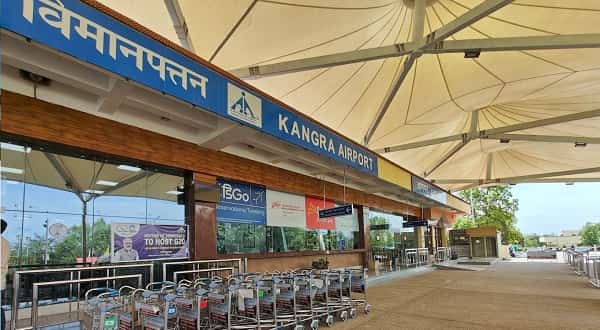
Quick Overview: Kangra Airport
| Detail | Information |
| Official Name | Kangra Airport |
| Also Known As | Gaggal Airport / Dharamshala-Kangra Airport / Kangra-Gaggal Airport |
| Location | Gaggal, Kangra district, Himachal Pradesh, India |
| Serves | Kangra, Dharamshala, McLeod Ganj, Kangra Valley |
| Airport Type | Public/Military — Domestic |
| IATA Code | DHM |
| ICAO Code | VIGG |
| Owner/Operator | Airports Authority of India (AAI) |
| Foundation Stone | 15 October 1986 (by CM Virbhadra Singh) |
| Commercial Operations Began | 1990 (Vayudoot, Dornier 228) |
| Renamed to Kangra Airport | 2001 |
| Terminal Inaugurated | 2007 |
| Land Area | 1,269 acres |
| Runway Designation | 15/33 |
| Runway Length | 1,372 metres × 30 metres (asphalt) |
| Runway Extension (Phase 1) | To 1,900 m (under planning; requires bridge over Manjhi River) |
| Runway Extension (Phase 2) | To 3,010–3,110 m (ultimate target; highway realignment required) |
| Apron | 91 × 61 metres; 2 turboprop bays |
| Elevation | 770 m / 2,525 ft AMSL |
| Coordinates | 32°09′54″N, 76°15′48″E |
| Distance from Dharamshala | ~12–13 km southwest |
| Distance from Kangra | ~8 km |
| Distance from McLeod Ganj | ~18–22 km |
| Passengers (2025–26) | 1,64,056 (−21.8% YoY) |
| Aircraft Movements (2025–26) | 2,868 |
| Current Airlines | IndiGo, SpiceJet |
| Active Routes | Delhi, Chandigarh, Noida (DXN) |
| Operations Type | Day VFR (visual flight rules) |
| AAI Customer Satisfaction | Top rank, 2024 domestic airports survey |
Kangra Airport Location: Gaggal in the Kangra Valley
Kangra Airport is located at Gaggal on the Pathankot–Mandi National Highway 154, approximately 12 kilometres southwest of Dharamshala, 8 kilometres from Kangra city, and 14 kilometres from Kangra Railway Station. The coordinates are 32°09′54″N, 76°15′48″E, at an elevation of 770 metres above mean sea level — in the lower Kangra Valley before the terrain rises steeply toward the Dhauladhar range.
The valley setting creates the defining character of Kangra Airport as an operational facility. Unlike a hill-top tabletop runway, Gaggal’s runway is in the valley floor — but the surrounding peaks rise several thousand feet above it, creating visual and meteorological constraints that limit operations to clear-weather conditions. The Dhauladhar range towers to the northeast, providing spectacular views on approach but introducing the low cloud and fog conditions that make the airport weather-sensitive, particularly during monsoon (June to September) and winter fog periods.
The airport’s 1,269-acre footprint sits between the Manjhi River (a tributary of the Beas) and the NH-154 highway — geographical boundaries that have defined the runway expansion challenge for two decades. The Phase 1 expansion plan to extend the runway to 1,900 metres requires a bridge over the Manjhi River, for which the Central Water and Power Research Station (CWPRS) in Pune has given a go-ahead for the bridge design. Phase 2, which would extend further to 3,010 to 3,110 metres to accommodate narrow-body jets like the Airbus A320, would require the realignment of NH-154 and acquisition of land beyond Gaggal township — a far more complex undertaking.
The Fifteenth Finance Commission recommended ₹400 crore for the expansion, and additional disbursements of ₹460 crore have been confirmed. As of mid-2026, the expansion was at advanced planning stages with the CWPRS bridge clearance secured but physical construction not yet commenced.
Kangra Airport Code: IATA DHM and ICAO VIGG
The airport’s IATA code is DHM and its ICAO code is VIGG. DHM appears on all airline booking platforms, boarding passes, and baggage tags for the Dharamshala, Kangra, and McLeod Ganj catchment. VIGG places it in the VI northern India block. The airport appears in booking systems under both “Kangra” and “Dharamshala” — both refer to the same facility. Kangra Airport ranked first in AAI’s 2024 Customer Satisfaction Survey for domestic airports — a notable achievement for a small regional hill station airport.
Kangra Airport Terminal: A 2007 Building With 100-Passenger Capacity
The current terminal at Kangra Airport was inaugurated in 2007 alongside a runway extension to 1,372 metres. The terminal building handles both arrivals and departures from a single compact building, with a capacity of 100 passengers simultaneously — 50 in the arrival area and 50 in the departure area. The apron (91 × 61 metres) can accommodate two turboprop aircraft of the ATR-72 or Dash 8 Q400 class.
The current runway at 1,372 metres forces load penalties on all aircraft operating here. ATR-72 aircraft cannot take off with full passenger loads when temperatures are high or winds are unfavourable, meaning some seats are often left empty on departures to comply with weight restrictions. This is the primary technical reason for the runway expansion — even the Phase 1 extension to 1,900 metres would allow full ATR-72 capacity operations without penalty, significantly improving commercial viability for airlines.
The airport’s history began with Vayudoot’s Dornier 228 service in 1990. Jagson Airlines, Deccan Aviation, and Kingfisher Airlines all operated at various points. IndiGo launched Dharamshala as its 78th domestic destination, marking the airline’s first Himachal Pradesh presence. As of June 2026, IndiGo and SpiceJet operate from DHM to Delhi, Chandigarh, and Noida (Delhi’s new Noida International Airport DXN).
Kangra Airport Connectivity: IndiGo and SpiceJet to Delhi and Chandigarh
By Air: IndiGo is the primary carrier at Kangra Airport, operating regular services to Delhi (DEL/IGI) and Chandigarh (IXC). SpiceJet also serves the Delhi route. The longest flight from DHM — to Noida (DXN, Delhi’s new Jewar airport opened March 2026) — takes approximately 1 hour 40 minutes. Approximately 42 flights depart weekly across all routes as of early 2026. Confirm current schedules before booking — hill station airport frequencies are season-dependent and change with winter/summer schedules.
Weather Advisory: Kangra Airport operates under VFR (visual flight rules). Flights are routinely delayed or diverted during monsoon months (June–September) and winter fog periods. Travellers booking during these windows should allow buffer time or consider road alternatives. The Delhi to Dharamshala drive via NH-44 and Pathankot takes approximately 10 to 12 hours, while Chandigarh to Dharamshala takes approximately 5 to 6 hours.
By Road: HRTC (Himachal Road Transport Corporation) buses connect Gaggal and Dharamshala to Chandigarh, Delhi, Pathankot, and within Himachal Pradesh. Taxis are the practical local transport from the airport to Dharamshala city (approximately 30 to 40 minutes), McLeod Ganj (approximately 45 to 60 minutes), and Kangra town (approximately 15 to 20 minutes). Fares range from ₹300 to ₹700 depending on destination. HRTC buses from the airport to Dharamshala cost ₹30 to ₹60.
By Rail: Kangra Railway Station on the narrow-gauge Pathankot–Jogindernagar line is the nearest station, approximately 14 km from the airport. For broad-gauge connectivity, Pathankot Junction is approximately 90 km west — a major junction for trains to Delhi, Amritsar, and the rest of India.
Kangra Airport Amenities: Compact Terminal, Top-Ranked Customer Satisfaction
Despite its modest size, Kangra Airport has earned AAI’s top rank in customer satisfaction for domestic airports in 2024 — a recognition that reflects the quality of passenger experience relative to its scale rather than the quantity of facilities. The terminal has an information centre with maps and travel guidance for visitors exploring the Kangra Valley. Purified water stations are available throughout the terminal. A small retail outlet sells local handicrafts, Himachali woolens, and travel essentials — appropriate for a gateway to the Kangra Valley’s craft traditions. Restrooms are maintained. Seating is available in the departure lounge.
There is no commercial lounge in the premium sense, no multi-cuisine food court, and no duty-free retail. The compact two-turboprop apron means aircraft are within easy visual reach of the terminal. The valley backdrop of the Dhauladhar range — visible from the apron and terminal — makes the boarding experience visually memorable in a way that few Indian airports can match.
Ground transport is available immediately outside the terminal exit. Information on local taxis, HRTC buses, and pre-arranged hotel pickups is available at the information desk.
FAQs: Kangra Airport
Q1. What is the IATA code for Kangra Airport?
A: The IATA code is DHM and the ICAO code is VIGG. The airport is also known as Gaggal Airport and Dharamshala-Kangra Airport. Book using DHM or search “Dharamshala” or “Kangra” on airline platforms.
Q2. Which airlines fly to Kangra Airport?
A: IndiGo and SpiceJet operate from DHM as of mid-2026, serving Delhi, Chandigarh, and Noida (DXN). Confirm current schedules before booking as hill station frequencies change seasonally.
Q3. How far is Kangra Airport from McLeod Ganj and Dharamshala?
A: Dharamshala is approximately 12 to 13 km from the airport (30 to 40 minutes by taxi). McLeod Ganj is approximately 18 to 22 km (45 to 60 minutes depending on traffic and road conditions).
Q4. Is the runway at Kangra Airport being expanded?
A: Yes. AAI has a two-phase expansion plan — Phase 1 extends the runway to 1,900 metres (requires a bridge over the Manjhi River; CWPRS clearance secured), Phase 2 extends to 3,010 to 3,110 metres for narrow-body jet operations (requires NH-154 realignment). ₹460 crore has been disbursed for the expansion. Physical construction had not commenced as of mid-2026.
Q5. Are flights reliable at Kangra Airport year-round?
A: No. The airport operates under visual flight rules (VFR) and is weather-sensitive. Monsoon season (June–September) and winter fog periods cause frequent delays and diversions. Always book with buffer time during these seasons.


