In 2024–25, Rajiv Gandhi International Airport at Shamshabad handled 2,91,65,232 passengers — a 16.5% year-on-year surge that placed it among India’s fastest-growing major aviation hubs. By calendar year 2025, total passengers crossed 31 million, registering 10.5% growth. The airport ranked fourth-fastest growing globally by seat capacity in 2024–25. In 2025 alone it won the Skytrax award for Best Airport Staff in India and South Asia. It processes pharmaceutical cargo on a temperature-controlled platform that is India’s first fully pharma-compliant cargo zone, handling 178,026 metric tonnes of cargo in 2025 against a designed capacity of 150,000 — running over capacity, signalling urgency for the new cargo terminal set to open early 2026. Opened on 23 March 2008 as India’s first greenfield PPP airport, operated by GMR Hyderabad International Airport Limited, carrying IATA code HYD and ICAO code VOHS, and located at Shamshabad approximately 24 kilometres south of the city — RGIA is the aviation engine of India’s pharmaceutical, IT, and bioscience capital.
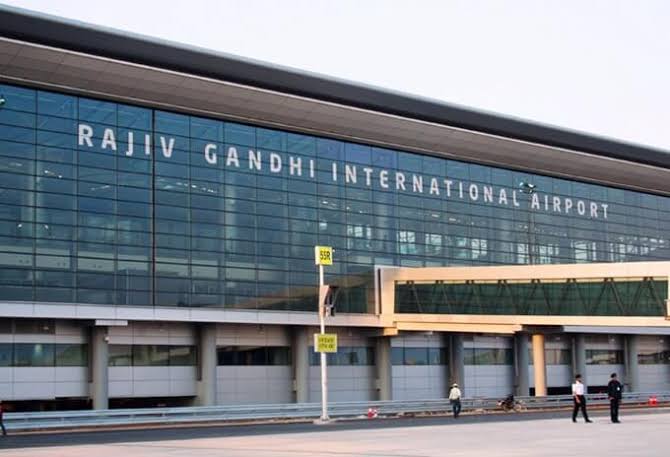
Quick Overview: Rajiv Gandhi International Airport
| Detail | Information |
| Official Name | Rajiv Gandhi International Airport (RGIA) |
| Also Known As | Hyderabad Airport; HYD Airport; Shamshabad Airport |
| Location | Shamshabad, Hyderabad, Telangana, India |
| Airport Type | Public — International |
| IATA Code | HYD |
| ICAO Code | VOHS |
| Owner/Operator | GMR Hyderabad International Airport Limited (GHIAL) — GMR 74%, AAI 13%, Govt of Telangana 13% |
| Opened | 23 March 2008 (India’s first greenfield PPP airport) |
| Hub for | Alliance Air, Amazon Air, Blue Dart Aviation, IndiGo, SpiceJet, Star Air |
| Focus City for | Air India |
| Operating Base for | Air India Express |
| Terminal | Single integrated terminal (domestic + international) |
| Terminal Expansion (2024) | Raised capacity to 34 million pax/year |
| Elevation | 617 m / 2,024 ft AMSL |
| Coordinates | 17°13′48″N, 78°25′55″E |
| Distance from City Centre | ~24 km south |
| Passengers (2024–25) | 2,91,65,232 (+16.5% YoY) |
| Passengers (CY 2025) | 31 million (+10.5% YoY) |
| Aircraft Movements (2024–25) | 2,02,395 (+14.8% YoY) |
| Cargo Tonnage (2025) | 1,78,026 MT (+11.9%; over design capacity of 1,50,000 MT) |
| New Cargo Terminal | Opening early 2026; capacity to 3,50,000 MT |
| New Terminal 2 | Master plan 2025; land levelling 2026; civil construction 2027–28 |
| Long-term Capacity Target | 80 million passengers by 2031 |
| Pharma Zone | India’s first temperature-controlled pharma cargo zone |
| Awards | Best Airport Staff India & South Asia (Skytrax 2025); LEED Platinum; ACI ASQ top rankings |
Hyderabad Airport Location: Shamshabad, 24 km From Charminar
Rajiv Gandhi International Airport is located in Shamshabad, approximately 24 kilometres south of Hyderabad’s historic centre (Charminar area) and approximately 35 km from the IT corridor of Hitec City and Madhapur. The coordinates are 17°13′48″N, 78°25′55″E, at an elevation of 617 metres above sea level — the Deccan plateau terrain of the Rangareddy district.
The airport’s distance from the IT corridor — the primary driver of its business passenger demand — has been the most persistent criticism of its location. Hitec City, where Amazon, Microsoft, Google, and hundreds of technology companies have campuses, is approximately 35 km from the airport. In typical Hyderabad traffic, this journey takes 45 to 90 minutes depending on the hour.
Hyderabad’s pharma industry gives the airport cargo mission particular weight. The city hosts the world’s largest concentration of bulk pharmaceutical manufacturers — companies like Dr. Reddy’s, Cipla, Mylan (Viatris), Divi’s Laboratories, and Aurobindo Pharma all operate from the Genome Valley and Jeedimetla corridors. The RGIA pharma cargo zone — with active and passive temperature control, cold-chain compliance, and international handling standards — processes vaccines, bulk drugs, and clinical trial materials for export across four continents.
Hyderabad Airport Code: IATA HYD and ICAO VOHS
The IATA code is HYD and the ICAO code is VOHS. HYD is one of the most-searched airport codes on Indian booking platforms — the gateway for 31 million annual passengers. VOHS places it in the VO southern India block. GHIAL operates the airport under a public-private concession, holding 74% with AAI (13%) and the Government of Telangana (13%) as partners.
Hyderabad Airport Terminal: Single Integrated Hub, New Terminal Coming
RGIA’s single integrated terminal is the defining feature of its passenger experience. Unlike Mumbai (two separate terminals), Chennai (four terminal areas), or Delhi (three terminals), Hyderabad operates entirely from one building — domestic and international under one roof, connected airside. Passengers connecting between domestic and international legs walk within the same secure zone without exiting and re-entering security.
The 2024 terminal expansion raised annual capacity to 34 million passengers — a significant upgrade. The expansion added check-in counters, security lanes, gates, and commercial retail space. DigiYatra biometric boarding is operational at domestic gates. The LEED Platinum certification for the expansion reflects RGIA’s sustainability commitment — solar installations, rainwater harvesting, and energy-efficient systems are integrated into the terminal.
New Terminal 2: RGIA’s master plan for Terminal 2 was targeted for completion in 2025. Land levelling begins in 2026. Civil construction is expected in 2027–28 with a three-year build timeline. When operational, T2 will push total capacity significantly above 40 million passengers annually, working toward the 80-million long-term target by 2031.
Cargo Terminal: A new cargo terminal was set to open in early 2026, raising capacity from 150,000 to 350,000 metric tonnes annually — essential given the 178,026 MT handled in 2025 already exceeded the existing design capacity.
Hyderabad Airport Connectivity: IndiGo Hub With Global Reach
By Air (Domestic): IndiGo is the hub airline with the highest frequency, connecting Hyderabad to Delhi, Mumbai, Bengaluru, Chennai, Kolkata, Kochi, Ahmedabad, Jaipur, Goa, and every major domestic city. Air India (focus city), Air India Express (operating base), SpiceJet, Akasa Air, and Star Air all maintain significant domestic networks. Aircraft movements of 2,02,395 in 2024–25 — approximately 554 daily — rank RGIA among India’s top five by movement frequency.
By Air (International): HYD’s international network covers the Gulf comprehensively (Dubai, Sharjah, Abu Dhabi, Doha, Muscat, Riyadh, Jeddah, Kuwait, Bahrain), Southeast Asia (Singapore, Kuala Lumpur, Bangkok), and long-haul through Air India (London, New York, and other hub connections). Emirates, Etihad, Qatar Airways, Singapore Airlines, Malaysia Airlines, and Air Arabia all serve Hyderabad. The Gulf routes carry the Telugu diaspora’s homeland connectivity; Singapore and Southeast Asian routes carry IT sector business travel.
By Road: TSRTC air-conditioned airport express buses connect RGIA to Mehdipatnam, Ameerpet, Jubilee Hills, and other city zones at ₹250 to ₹350. Ola, Uber, and pre-paid taxi desks serve the airport. Travel time to Hitec City is 45 to 90 minutes; to the old city (Charminar area) is 45 to 60 minutes.
By Rail: Umdanagar MMTS Station is the nearest rail stop, requiring a taxi transfer to the terminal. A planned MMTS extension to the airport has been discussed for years without implementation as of mid-2026.
Hyderabad Airport Amenities: Award-Winning International Hub
The integrated terminal provides premium amenities on both domestic and international sides. The Encalm Lounge — on Level E in the domestic departure area — is the premium lounge managed by Encalm Hospitality, offering meals, shower facilities, and quiet work areas. Priority Pass and credit card lounges are available. Duty-free shopping covers the full international range including perfumes, liquor, electronics, and Indian handicrafts. Multiple restaurants serve Hyderabadi biryani, South Indian breakfast, and global café formats.
DigiYatra biometric boarding is operational at domestic gates. Free Wi-Fi is available. Currency exchange and ATMs are operational. Medical facilities and pharmacies are in place. Wheelchair assistance and free trolleys are provided. The airport’s pharma zone for cargo reflects its industrial ecosystem — passengers bound for pharma-related business will find the city’s industrial corridors all accessible within 45 minutes to 1 hour.
Arrive 2 hours before domestic and 3 hours before international departures — the 554 daily movements create peak-hour queues at security and check-in.
FAQs: Rajiv Gandhi International Airport
Q1. What is the IATA code for Hyderabad Airport?
HYD is the IATA code and VOHS is the ICAO code. The airport is officially Rajiv Gandhi International Airport, operated by GHIAL (GMR Group), located in Shamshabad approximately 24 km south of Hyderabad city centre.
Q2. Why is Hyderabad Airport significant for pharmaceutical cargo?
RGIA houses India’s first fully temperature-controlled pharma cargo zone, processing vaccines, bulk drugs, and clinical trial materials for export. Hyderabad is home to the world’s largest concentration of bulk pharmaceutical manufacturers, making RGIA the primary pharma export air gateway. In 2025, it handled 178,026 MT of cargo — exceeding its 150,000 MT design capacity.
Q3. How many passengers does RGIA handle?
2,91,65,232 in 2024–25 (+16.5%) and 31 million in calendar year 2025 (+10.5%). The airport is expanding to 80 million annual capacity by 2031 through Terminal 2 and runway additions.
Q4. What is the Terminal 2 project at Hyderabad Airport?
The master plan for Terminal 2 was targeted for 2025 completion. Land levelling begins 2026. Civil construction expected 2027–28 with a three-year build. T2 will push RGIA toward 40+ million annual capacity and eventually enable the 80-million target by 2031.
Q5. How do I get from RGIA to Hitec City (the IT corridor)?
Approximately 35 km north — about 45 to 90 minutes by taxi or Ola/Uber depending on traffic. TSRTC airport buses serve major city hubs at ₹250 to ₹350. No direct metro or MMTS rail link to the airport exists as of mid-2026.