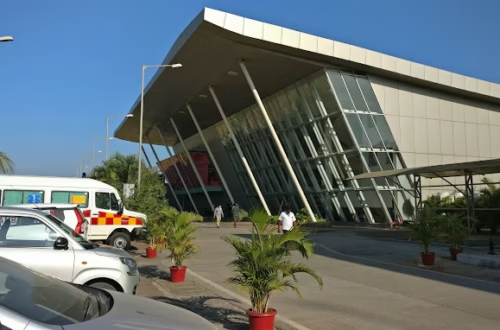
A mountaintop was cut down to build Shimla Airport. That sentence captures the engineering ambition and the physical constraint that have defined this airport since its construction in 1987 — a tabletop runway carved out of a ridge at Jubbarhatti, 22 kilometres from the colonial hill station that served as the summer capital of British India and now serves as the state capital of Himachal Pradesh. The airport that emerged from that mountaintop levelling is simultaneously one of India’s most technically interesting and most commercially fragile airports. Its runway is 1,230 metres long. It sits at 1,546 metres above sea level. It can park one ATR-42 class aircraft. Its terminal handles 50 arriving and 40 departing passengers at peak capacity. Every airline that has tried to make the Shimla route work — Vayudoot, Jagson, Archana Airways, Kingfisher, Alliance Air — has eventually suspended service for commercial or operational reasons. In January 2026, the Himachal Pradesh government committed ₹32 crore per year in Viability Gap Funding to bring Alliance Air back on the Delhi–Shimla–Dharamshala sector, with operations expected to begin in late April 2026.
Quick Overview: Shimla Airport
| Detail | Information |
| Official Name | Shimla Airport (Jubbarhatti Airport) |
| Location | Jubbarhatti, ~22 km southeast of Shimla, Himachal Pradesh |
| Airport Type | Public — Domestic |
| IATA Code | SLV |
| ICAO Code | VISM |
| Owner | Government of India |
| Operator | Airports Authority of India (AAI) |
| Built | 1987 (mountaintop levelled) |
| Runway Type | Tabletop |
| Runway Length | 1,230 metres |
| Elevation | 1,546 m / 5,072 ft AMSL |
| Coordinates | 31°04′54″N, 77°04′05″E |
| Apron Capacity | 1 ATR-42 class aircraft |
| Terminal Capacity | 50 arrivals / 40 departures |
| Passengers (2024–25) | 25,493 (+19.3% YoY) |
| Aircraft Movements (2024–25) | 1,166 (+40.3% YoY) |
| Current Airline | Alliance Air |
| Active Routes | Delhi, Dharamshala (from late April 2026) |
| State VGF Commitment | ₹32.64 crore/year for Delhi–Shimla–Dharamshala sector |
| Operations Type | Day VFR; weather-sensitive; no instrument approach |
Shimla Airport Location: A Tabletop at Jubbarhatti
Shimla Airport is located at Jubbarhatti village, approximately 22 kilometres southeast of Shimla city centre. The coordinates are 31°04′54″N, 77°04′05″E, at an elevation of 1,546 metres above mean sea level — making it one of India’s highest-altitude commercial airports. The runway is a classic tabletop design: carved by cutting the top off a ridge, leaving a flat surface with steep drop-offs at both ends and the valley floor hundreds of metres below.
The approach to Jubbarhatti is visually arresting and operationally demanding. Aircraft arriving from Delhi descend through the Shimla ridge system, navigating valleys before lining up for the runway on the ridgetop. The departure is equally striking — aircraft lift off from what feels like the edge of a plateau and immediately enter open airspace above the gorges. The hot-and-high conditions (high altitude plus warm temperatures) reduce aircraft engine and wing efficiency, meaning weight restrictions are standard. Kingfisher Airlines’ Delhi–Shimla service was limited to 28 passengers on return sectors because of these load penalties.
Jubbarhatti village is approximately 22 km from Shimla city, reachable in 45 to 60 minutes by road — the winding hill road making actual travel time longer than the straight-line distance suggests. The road passes through forested ridges characteristic of the sub-Himalayan zone south of Shimla.
Shimla Airport Code: IATA SLV and ICAO VISM
The airport’s IATA code is SLV and its ICAO code is VISM. SLV is used in airline booking systems and appears on boarding passes for Shimla. VISM places it in the VI northern India block. The airport does not publish METAR data — weather references for pilot planning come from the nearest available stations rather than Jubbarhatti itself.
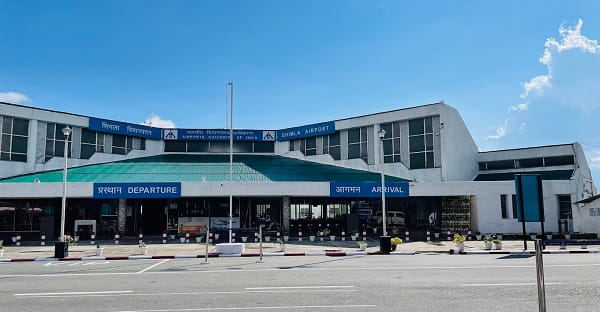
Shimla Airport Terminal: The Smallest State Capital Airport in India
Shimla Airport’s terminal is one of the smallest at any Indian state capital. The single terminal building handles both arrivals and departures from one compact structure, with a maximum capacity of 50 passengers in the arrival area and 40 passengers in the departure area — 90 passengers total across both streams. The apron has parking space for one ATR-42 class aircraft, making simultaneous multi-aircraft operations impossible.
The terminal offers essential passenger services — check-in counters, security screening, a small departure waiting area, and arrivals baggage claim. Restrooms are available. There is no commercial lounge, no food court, no retail beyond basic essentials, and no duty-free. The airport is clean and functional at its scale.
Shimla Airport’s operational history is defined by repeated service suspension. Vayudoot operated early services. Jagson Airlines flew Shimla–Kullu–Delhi for a period. Archana Airways attempted the route. Kingfisher Airlines ran the Delhi service until September 2012 when the airline collapsed. Alliance Air revived service on 27 April 2017 under the UDAN scheme (PM Modi inaugurated the maiden Shimla–Delhi UDAN flight that day). Alliance Air then suspended in March 2020 during COVID-19 and resumed on 26 September 2022. Service has been intermittent since, with commercial viability remaining the persistent challenge.
In January 2026, the Himachal Pradesh Cabinet approved providing ₹32.64 crore annually in Viability Gap Funding to Alliance Air for operating 46-seater ATR 42-600 aircraft daily on the Delhi–Shimla–Delhi and Shimla–Dharamshala–Shimla routes. The Himachal Pradesh government and Alliance Air signed an MoU in early 2026, with operations targeted to begin in the last week of April 2026. As of mid-2026, these flights were active or in imminent commencement — confirm current status before booking.
Shimla Airport Connectivity: Alliance Air to Delhi and Dharamshala
By Air: Alliance Air operates the current scheduled services from Shimla Airport — daily Delhi–Shimla and Shimla–Dharamshala services using 46-seat ATR 42-600 aircraft, backed by Himachal Pradesh government’s ₹32.64 crore annual VGF. Dharamshala (DHM, Kangra Airport at Gaggal) is approximately 35 to 45 minutes by air from Shimla — creating an intra-Himachal Pradesh air link of genuine practical value for government officials, tourism sector workers, and travellers connecting between the state capital and the Dalai Lama’s base. The Delhi flight takes approximately 1 hour. Confirm current operational status before booking — Shimla’s service has historically been the most on-off of any Himachal Pradesh airport.
Weather advisory: Shimla Airport is the most weather-sensitive commercial airport in India by most practical measures. The tabletop runway, high elevation, surrounding gorges, and rapidly changing Shimla valley weather make cancellations and diversions a routine occurrence rather than an exception. The HappyFares 2026 guide states plainly: “No regular commercial flights in 2026 — runway constraints and weather make service unreliable.” With the new VGF arrangement, attempts are being made to provide more consistent service, but travellers with critical onward connections should always have road alternatives planned.
Best Alternative Route: The practical solution for most Shimla-bound travellers is to fly to Chandigarh (IXC) and travel the 115 km to Shimla by road (approximately 3 to 4 hours by taxi or HRTC Volvo bus). Alternatively, a taxi to Kalka followed by the Kalka–Shimla UNESCO Heritage Railway (a scenic narrow-gauge train) is a memorable and reliable option.
By Road: Shimla is connected by NH-5 to Chandigarh (approximately 115 km, 3 to 4 hours) and via Chandigarh to Delhi (approximately 370 km total, 7 to 8 hours). HRTC Volvo buses operate overnight services from Delhi to Shimla. The Jubbarhatti airport itself is approximately 22 km from Shimla city — taxis from the airport to the city cost approximately ₹500 to ₹800.
By Rail: The Kalka–Shimla Mountain Railway — a UNESCO World Heritage railway — connects Shimla to Kalka railway station (approximately 96 km, 5 hours on the narrow-gauge heritage train) where broad-gauge connections to Chandigarh, Ambala, and Delhi are available. It is one of India’s most scenic rail journeys, though slower than road for time-conscious travellers.
Shimla Airport Amenities: Essential Services at India’s Highest State Capital Airport
Shimla Airport’s amenities are entirely consistent with a terminal designed for 90 passengers at peak capacity. Check-in counters serve Alliance Air. Security screening is in place. The departure waiting area has seating. Restrooms are maintained. Pawan Hans helicopter services operate from the airport alongside fixed-wing commercial operations, serving the Himachal Pradesh government’s inter-valley connectivity needs.
The airport’s extreme compactness — one aircraft, one terminal, 90-person capacity — makes the passenger experience unusually personal by Indian airport standards. There is no congestion, no queuing at security for minutes, and no labyrinthine terminal navigation. The flip side is that delays or disruptions affect all passengers simultaneously, and weather cancellations with no aircraft on stand mean stranded passengers must arrange road transport with no alternative flights available.
Taxi services operate from Jubbarhatti to Shimla city. No formal pre-paid taxi desk operates given the airport’s scale; drivers waiting outside the terminal serve arriving passengers. Hotels at multiple price points within Shimla city are approximately 45 to 60 minutes away by road.
FAQs: Shimla Airport
Q1. What is the IATA code for Shimla Airport?
A: The IATA code is SLV and the ICAO code is VISM. The airport is officially named Shimla Airport and also known as Jubbarhatti Airport, located 22 km southeast of Shimla city.
Q2. How was Shimla Airport built?
A: The airport was constructed by cutting down a mountaintop and levelling the ridge at Jubbarhatti to form a tabletop runway. This engineering approach is common for hill station airports but results in a steep drop-off at runway ends and demanding approach and departure paths.
Q3. Which airline currently flies from Shimla Airport?
A: Alliance Air operates daily Delhi–Shimla and Shimla–Dharamshala services using 46-seat ATR 42-600 aircraft, supported by ₹32.64 crore annual Viability Gap Funding from the Himachal Pradesh government. Operations were targeted for late April 2026 onward. Confirm current status before booking.
Q4. Why have flights at Shimla Airport historically been so unreliable?
A: Multiple factors: the 1,230-metre tabletop runway imposes significant load restrictions; the 1,546-metre elevation creates hot-and-high performance penalties; Shimla’s valley weather changes rapidly with fog, cloud, and crosswinds; and commercial viability without state subsidy has never been demonstrated. Every airline that has served Shimla has eventually suspended due to these compounding challenges.
Q5. What is the best way to get to Shimla if flights are cancelled?
A: Fly to Chandigarh (IXC) instead, then travel 115 km to Shimla by taxi (3 to 4 hours) or HRTC Volvo bus. Alternatively, take a taxi to Kalka and board the UNESCO Heritage Kalka–Shimla narrow-gauge railway (5 hours, highly scenic). These alternatives are more reliable than depending on Shimla’s direct flight given its weather sensitivity.