Chennai is India’s automobile capital, the gateway to Dravidian heritage, and the city where the Bay of Bengal meets one of Asia’s longest urban beaches. It is also Tamil Nadu’s economic engine — home to the world’s second-largest automobile manufacturing cluster, a significant IT sector in Tidel Park and OMR, one of India’s busiest ports, and a healthcare corridor anchored by Apollo, Fortis, and MIOT hospitals that attracts medical tourists from across South and Southeast Asia. Chennai International Airport — carrying IATA code MAA and ICAO code VOMM, located at Tirusulam approximately 15 to 18 kilometres southwest of the city centre — is India’s fourth or fifth busiest airport depending on the year, handled 2,30,17,324 passengers in 2025–26, and carries 4,22,515 tonnes of cargo annually, the highest cargo volume among southern Indian airports. Its name MAA preserves the colonial name Madras even a generation after the city was renamed Chennai in 1996. Its infrastructure is currently mid-transformation — a ₹2,467 crore expansion replacing older terminals with a new integrated T3 and satellite terminal.
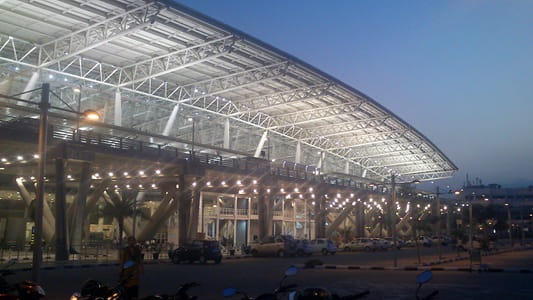
Quick Overview: Chennai International Airport
| Detail | Information |
| Official Name | Chennai International Airport (also: Meenambakkam Airport) |
| Location | Tirusulam / Meenambakkam, Chennai, Tamil Nadu, India |
| Airport Type | Public — International |
| IATA Code | MAA |
| ICAO Code | VOMM |
| Owner | Ministry of Civil Aviation |
| Operator | Airports Authority of India (AAI) |
| History | Airstrip from 1910–1915; commissioned 1930; WWII military base |
| Hub for | Blue Dart Aviation |
| Focus City for | Air India |
| Operating Base for | IndiGo |
| Area | 1,301 acres |
| Runways | 2 asphalt (07/25 and 07L/25R) |
| Elevation | 16 m / 52 ft AMSL |
| Coordinates | 12°58′56″N, 80°09′49″E |
| Distance from City Centre | ~15–18 km southwest |
| Terminals | T1 (domestic/Kamaraj), T2 (international/Anna), T4 (domestic); T3 integrated new terminal phased in from April 2023 |
| Passengers (2025–26) | 2,30,17,324 (+2.7% YoY) |
| Aircraft Movements (2025–26) | 1,58,702 (+1.6% YoY) |
| Cargo Tonnage (2025–26) | 4,22,515.9 tonnes (+11.4% YoY) |
| Expansion Project | ₹2,467 crore; 2.36 lakh sq. metres; T3 new integrated terminal |
Chennai Airport Location: Tirusulam, 15 km From Fort St. George
Chennai International Airport is located in Tirusulam (also referred to as Meenambakkam, the older locality name), approximately 15 to 18 kilometres southwest of Chennai’s historic core at Fort St. George and Chepauk. The coordinates are 12°58′56″N, 80°09′49″E, at an elevation of just 16 metres above sea level — the flat coastal plain of Tamil Nadu’s eastern seaboard.
The airport’s 1,301-acre footprint sits in one of Chennai’s most transit-intensive corridors — the airport is directly accessible from the MRTS (Mass Rapid Transit System), suburban rail at Tirusulam station, and the extended Chennai Metro’s airport line. Marina Beach — the second-longest urban beach in the world — is approximately 13 km east. The IT corridor of OMR (Old Mahabalipuram Road) is approximately 20 km. Mahabalipuram UNESCO Shore Temple is approximately 55 km south.
Chennai’s medical tourism sector — particularly for cardiac surgery, oncology, and transplants at hospitals like Apollo and MIOT — generates substantial international arrivals from Sri Lanka, Southeast Asia, the Middle East, and East Africa, giving MAA a unique healthcare-travel passenger stream unlike any other Indian metro airport.
Chennai Airport Code: IATA MAA and ICAO VOMM
The IATA code is MAA — the three letters reflecting the city’s former name Madras, assigned when the airport was first coded in the international aviation system and never changed after the 1996 renaming. ICAO code VOMM places it in the VO southern India block. MAA is searchable as both “Chennai” and “Madras” on most airline booking platforms. The airport operates 24/7, and is ranked India’s fourth or fifth busiest airport.
Chennai Airport Terminal: Four Terminal Areas, Ongoing ₹2,467 Crore Transformation
Chennai Airport’s terminal configuration is in transition — understanding the current state is essential before travel.
Terminal 1 (Kamaraj Domestic Terminal): T1 handles most domestic departures. Named after K. Kamaraj, the legendary Tamil Nadu Chief Minister and former INC president. IndiGo, SpiceJet, Air India, and other domestic carriers operate from here. Multiple aerobridges, check-in counters, security lanes, departure gates, and the domestic arrivals hall are in T1. Domestic lounges accessible via credit cards (HDFC, ICICI, SBI, Axis) and Priority Pass are available.
Terminal 2 (Anna International Terminal): T2 handles all international departures and arrivals, named after former Tamil Nadu CM C.N. Annadurai. International immigration, customs, duty-free shopping, international airlines’ check-in, and departure gates are in T2. Larger international lounges with shower facilities serve business-class and lounge-eligible international passengers.
Terminal 4: An additional domestic terminal area within the complex, used by specific carriers for selected routes. Always confirm your terminal with your airline before arrival.
New Terminal 3 (T3) — The ₹2,467 Crore Project: AAI launched the terminal expansion in 2018 at ₹2,467 crore to raise annual capacity from 2.3 crore to 3.5 crore passengers. Phase 1 — a new integrated terminal of 1.36 lakh square metres — was opened by PM Modi in April 2023. Phase 2 expansion to complete the full T3 and satellite terminal was targeted for March 2026. Once fully operational, T3 replaces the older terminal structures, raises capacity to 3.5 crore, and enables 500+ daily flights. A dedicated air cargo complex operates from the old passenger terminal at Meenambakkam.
Chennai Airport Connectivity: Four Continents and 500+ Weekly Departures
By Air (Domestic): IndiGo (operating base), Air India (focus city), SpiceJet, Akasa Air, and Air India Express connect Chennai to Delhi, Mumbai, Bengaluru, Hyderabad, Kolkata, Kochi, Coimbatore, Madurai, Tiruchirappalli, Bengaluru, and a comprehensive domestic network. Aircraft movements of 1,58,702 in 2025–26 — approximately 434 daily — rank MAA among India’s top five for movement frequency.
By Air (International): Sri Lanka (Colombo), Singapore, Malaysia (Kuala Lumpur), Bangkok, Dubai, Abu Dhabi, Doha, Riyadh, Jeddah, Muscat, London, Frankfurt, Paris, and multiple Gulf and Southeast Asian cities are served directly. Air India, IndiGo, Singapore Airlines, Malaysia Airlines, Sri Lankan Airlines, Emirates, Qatar Airways, Etihad, and others maintain scheduled international services. Chennai’s international cargo of 4,22,515 tonnes reflects the automobile parts, pharmaceutical, and electronics export ecosystem of Tamil Nadu.
By Road: Taxis, Ola, Uber, and pre-paid taxi desks serve the airport. Travel time to central Chennai (T. Nagar, Egmore area) is approximately 30 to 50 minutes in normal traffic. The airport Metro station connects directly to the Chennai Metro network.
By Rail and Metro: Tirusulam MRTS Station is adjacent to the airport — connected to Chennai Beach station and the Suburban Railway network. Chennai Metro’s airport extension connects the airport to central Chennai stations. The nearest major railway station, Chennai Egmore, is approximately 14 km from the airport.
Chennai Airport Amenities: South India’s Premier Aviation Hub
T2’s international area has duty-free shopping covering the full range — perfumes, liquor, electronics, clothing, and local Tamil Nadu specialities including silk fabrics and bronze idols. Multiple restaurants serve Chettinad cuisine, Tamil breakfast items (idli, dosa, filter coffee), and global café formats. Domestic terminal lounges are available via credit card access and Priority Pass in T1.
Free Wi-Fi is available throughout all terminals. Wheelchair assistance and free trolleys are provided. Medical facilities are in place. Battery-operated vehicles and courtesy coaches connect domestic and international terminals for transit passengers. Currency exchange counters and ATMs are in all terminal areas. The 24/7 operation accommodates the late-night and early-morning international flight windows that dominate Chennai’s Gulf and Southeast Asia traffic.
FAQs: Chennai International Airport
Q1. What is the IATA code for Chennai Airport?
The IATA code is MAA (from Madras, the city’s former name) and the ICAO code is VOMM. Search “Chennai” or “MAA” on booking platforms. The airport is at Tirusulam, approximately 15 to 18 km southwest of Chennai city.
Q2. How many terminals does Chennai Airport have?
Four terminal areas — T1 (Kamaraj, domestic), T2 (Anna, international), T4 (domestic), and the new T3 integrated terminal phased in from April 2023. Always confirm your terminal with the airline before travel.
Q3. What is the ₹2,467 crore expansion at Chennai Airport?
AAI’s expansion project (2018 onward) covers 2.36 lakh square metres in two phases. Phase 1 opened April 2023 (new T3, 1.36 lakh sq. metres). Phase 2 completes the satellite terminal and raises annual capacity to 3.5 crore passengers. March 2026 was the revised Phase 2 target — confirm current status before planning.
Q4. Does Chennai Airport have Metro connectivity?
Yes. A Chennai Metro station at the airport connects to the city’s Metro network. The MRTS suburban rail station at Tirusulam is also adjacent to the airport.
Q5. What makes Chennai Airport notable for cargo?
MAA handled 4,22,515 tonnes of cargo in 2025–26 — an 11.4% increase — the highest cargo volume among south Indian airports. This reflects Tamil Nadu’s automobile parts, pharmaceutical, electronics, and textile export industries, as well as Chennai Port’s feeder cargo flows.