Kozhikode has a history that begins not with India’s independence but with the spice trade routes that made this Malabar port one of the world’s most strategically important cities for over a millennium. Vasco da Gama arrived here in 1498 — the culmination of Portugal’s search for a direct sea route to the spices that had made Kozhikode’s Zamorin ruler one of the medieval world’s wealthier sovereigns. The city’s more recent history involves another kind of global connection: Kerala’s Gulf diaspora. Kozhikode International Airport — officially known as Calicut International Airport, carrying IATA code CCJ and ICAO code VOCL, and physically located in Karipur in Malappuram district despite serving Kozhikode — is the third-busiest airport in Kerala and the twelfth-busiest in India. Its tabletop runway at Karipur, its two terminals, and its role as an Air India Express operating base have made it the air gateway to both Kozhikode and Malappuram — a combined catchment of roughly 9 million people — since it opened on 13 April 1988. In 2024–25 it handled 36.95 lakh passengers and 21,246 tonnes of cargo.
Quick Overview: Kozhikode International Airport
| Detail | Information |
| Official Name | Calicut International Airport / Kozhikode International Airport |
| Also Known As | Karipur Airport |
| Location | Karipur, Kondotty, Malappuram district, Kerala, India |
| Serves | Kozhikode and Malappuram |
| Airport Type | Public — International |
| IATA Code | CCJ |
| ICAO Code | VOCL |
| Owner/Operator | Airports Authority of India (AAI) |
| Operating Base for | Air India Express |
| Opened | 13 April 1988 |
| International Status | 2006 |
| Runway | Tabletop; 09/27 |
| Runway Length | ~2,743 m (extended from 6,000 ft to 9,000 ft / ~1,829 m to 2,743 m) |
| Elevation | 104 m / 342 ft AMSL |
| Coordinates | 11°08′10″N, 75°57′18″E |
| Distance from Kozhikode City | ~28 km |
| Distance from Malappuram | ~30 km |
| Domestic Terminal (T1) | 5,531.16 sq. metres; 9 check-in counters; 2 security kiosks; 250 in + 250 out capacity |
| International Terminal (T2) | 18,249.41 sq. metres; 23 check-in counters; 18 immigration (departure) + 14 (arrival) |
| Passengers (2024–25) | 36,95,944 (+11.3% YoY) |
| Aircraft Movements (2024–25) | 26,381 (+8% YoY) |
| Cargo Tonnage (2024–25) | 21,246 tonnes (+16.3% YoY) |
| Airlines | IndiGo, Air India Express, Air India, SpiceJet, Etihad, Qatar Airways, Oman Air, Air Arabia, flydubai |
| International Routes | Dubai, Sharjah, Abu Dhabi, Doha, Muscat, Riyadh, Jeddah, Bahrain, Ras al Khaimah, Kuala Lumpur |
Kozhikode International Airport Location: Karipur in Malappuram, Not Kozhikode
The geographic anomaly of Kozhikode International Airport is worth stating clearly: the airport is not in Kozhikode district. It is located at Karipur in Kondotty taluka, Malappuram district — approximately 28 kilometres from Kozhikode city and roughly 30 kilometres from Malappuram city. The airport’s official IATA/AAI name — Calicut International Airport — preserves the colonial name “Calicut” for Kozhikode, while the physical facility sits in a different administrative district entirely.
This cross-district positioning means the airport genuinely serves two major population centres. Kozhikode, Kerala’s third-largest city, is the historic Malabar capital — known for its biryani, its maritime heritage, its large Muslim mercantile community, and its long intellectual tradition. Malappuram, one of Kerala’s most densely Gulf-connected districts, has a diaspora density that is among the highest in India — generating enormous air travel demand concentrated on Gulf routes. The combined Kozhikode-Malappuram catchment of roughly 9 million people makes CCJ’s traffic the product of overlapping demand streams that happen to converge on a single tabletop plateau at Karipur.
The airport sits at 104 metres above mean sea level, on a plateau that drops sharply on surrounding sides — a tabletop runway configuration similar to Mangaluru Airport. The 2010 Air India Express tragedy at Mangaluru heightened regulatory focus on tabletop airports across India, leading to safety audits and enhanced pilot training requirements specifically mentioning Karipur alongside Mangaluru.
Kozhikode International Airport Code: IATA CCJ and ICAO VOCL
The airport’s IATA code is CCJ — derived from “Calicut (C) Calicut (C) Jet (J)” in various folk etymologies, though the assignment reflects the city’s colonial name. Its ICAO code is VOCL. CCJ is the booking identifier across all airline systems. VOCL places it in the VO southern India block. The airport received international status in 2006, enabling direct DGCA licensing for international operations beyond its earlier scheduled international flights which had operated under temporary permissions.
Kozhikode International Airport Terminal: Two Buildings for Domestic and International Flows
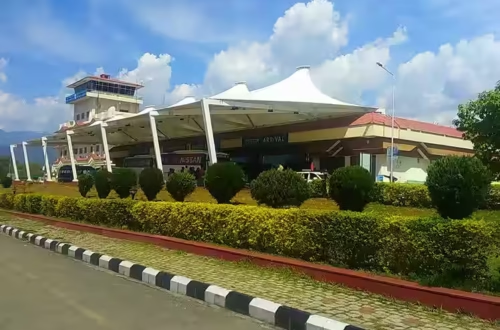
Terminal 1 (Domestic): The domestic terminal at CCJ covers 5,531.16 square metres with 9 check-in counters and 2 security kiosks. It can handle 250 incoming and 250 outgoing passengers simultaneously. The terminal has two entry and exit gates providing easy access. Air India uses T1 as a hub for domestic operations. Basic amenities including seating, restrooms, and food counters are available. The terminal is compact — passengers experience short walking distances between check-in and boarding.
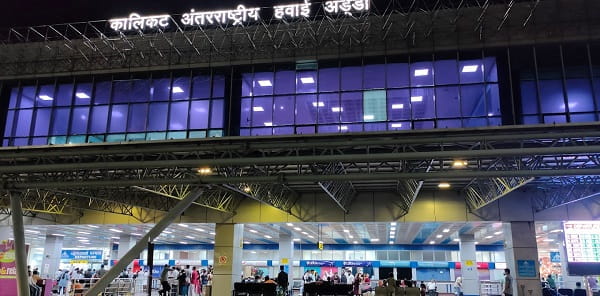
Terminal 2 (International): The international terminal covers 18,249.41 square metres — more than three times the domestic terminal’s footprint — reflecting the enormous international traffic throughput that defines CCJ. It has 23 check-in counters, 18 immigration counters at departure and 14 at arrival, 1 customs counter at departure plus 4 at arrival, and 3 security checkpoints. Duty-free retail, currency exchange, ATMs, restaurants, and shops are available within the international terminal.
Historical Funding Note: The airport’s initial development in the 1980s received funding from Gulf Malayalis — overseas Keralite workers who contributed financially to the construction of their home region’s airport — a collective act of diaspora investment in connectivity that was widely documented and that resonates today given the airport’s continued role in serving the same community’s travel needs.
Tabletop Safety: The runway sits on a plateau at 104 metres with steep drops on surrounding sides. Pilots operating into CCJ undergo mandatory DGCA-specified simulator training for tabletop approaches. The runway was extended from its original 6,000 feet to 9,000 feet (approximately 1,829 to 2,743 metres) — a significant upgrade that enabled wide-body and larger narrow-body aircraft operations. The 24/7 operations enable early morning Gulf arrivals and late-night departures, which are the dominant traffic pattern.
Kozhikode International Airport Connectivity: Gulf at Scale and Domestic Network
By Air (Domestic): IndiGo operates more than 50 non-stop weekly flights to key destinations from CCJ, connecting Kozhikode to Bengaluru, Chennai, Delhi, Mumbai, Hyderabad, and Kochi. Air India, Air India Express, and SpiceJet also serve domestic routes. The combination of Kozhikode and Malappuram demand sustains higher domestic frequencies than either city could support alone.
By Air (International): International carriers serving CCJ include AirAsia, Flynas, Air Arabia Abu Dhabi, SpiceJet, Air India Express, Etihad Airways, Oman Air, Qatar Airways, Air Arabia, IndiGo, flydubai, and Gulf Air. Gulf routes dominate — Dubai, Sharjah, Abu Dhabi, Doha, Muscat, Riyadh, Jeddah, Bahrain, and Ras al Khaimah are all directly served. Kuala Lumpur is a notable non-Gulf international destination, reflecting the Keralite community in Malaysia. Cargo tonnage of 21,246 tonnes in 2024–25 (+16.3%) — among the highest for a non-metro airport — reflects the density of remittance-related cargo, gold (brought back by returning Gulf workers), and seafood exports from the Malabar coast.
By Road: KSRTC special low-floor air-conditioned buses regularly ply between the airport and key points in the city, including the bus station and railway station. Pre-paid taxis are available at the airport exit. App-based cabs serve the route. The journey from the city to the airport usually takes between 45 to 90 minutes, depending on traffic conditions.
By Rail: The airport is 30 km from the Calicut Railway Station. Kozhikode (Calicut) is a major railway junction on the Shoranur-Mangaluru line with connections to Thiruvananthapuram, Ernakulam, Thrissur, Palakkad, Coimbatore, Chennai, and Mumbai via the Kerala coast and the Konkan Railway.
Kozhikode International Airport Amenities: Gulf-Ready International Terminal
Currency exchange counters, ATMs, car rental desks, and several cafes where passengers can have a snack while waiting for flights are available throughout the terminal complex. The international terminal provides duty-free shopping for international departing passengers — important for Gulf-bound travellers and for returning Gulf workers bringing gold and electronics. The domestic terminal’s 9 counters handle domestic airlines efficiently at its 500-passenger combined capacity.
Kozhikode Airport offers round-the-clock arrival and departure — the 24/7 operation is essential for Gulf flights whose peak window clusters between 1 AM and 6 AM. Premium and pay-access lounges are available near international departure gates. Parking for over 800 vehicles — with 371 spots at the international terminal and 171 at the domestic terminal — accommodates the large volumes of family members accompanying returning Gulf workers to the airport. Prayer rooms serve the predominantly Muslim traveller profile of this airport’s international passenger base.
Medical facilities and a lost and found service operate within the terminal. Baggage trolleys and wrapping services are available. Wi-Fi is accessible. The airport’s proximity to the Malabar coast means arriving travellers are within reach of Calicut Beach, the Pazhassi Raja Museum, and the culinary scene of Kozhikode — justly famous for its Malabar biryani and halwa.
FAQs: Kozhikode International Airport
Q1. What is the IATA code for Kozhikode International Airport?
A: The IATA code is CCJ and the ICAO code is VOCL. The airport is officially named Calicut International Airport and is also known as Karipur Airport. Book using CCJ or search “Kozhikode” or “Calicut” on airline platforms.
Q2. Why is Kozhikode Airport located in Malappuram district?
A: The airport is physically at Karipur in Kondotty taluka, Malappuram district — approximately 28 km from Kozhikode and 30 km from Malappuram city. It serves both major population centres, which is why it carries the Kozhikode/Calicut name despite being in Malappuram district.
Q3. What is the runway type at Kozhikode Airport?
A: Tabletop — a plateau runway with steep drops on surrounding sides. The runway was extended from 6,000 feet to 9,000 feet (approximately 1,829 to 2,743 metres). Mandatory pilot training for tabletop approaches at CCJ is required by DGCA.
Q4. Which Gulf destinations are served from Kozhikode Airport?
A: Dubai, Sharjah, Abu Dhabi, Doha, Muscat, Riyadh, Jeddah, Bahrain, and Ras al Khaimah are among the direct Gulf routes. Multiple international carriers operate these services, including Air India Express, IndiGo, flydubai, Air Arabia, Qatar Airways, Oman Air, Etihad, and others.
Q5. What is the cargo significance of Kozhikode Airport?
A: CCJ handled 21,246 tonnes of cargo in 2024–25 — a 16.3% increase year-on-year and among the highest cargo volumes for a non-metropolitan Indian airport. This reflects both the remittance economy (gold imports from Gulf workers), seafood exports from the Malabar coast, and general trade flows between Malappuram-Kozhikode’s business community and the Gulf.