The Kullu Valley has been drawing travellers for decades — the apple orchards, the Beas River, the Rohtang Pass, the Solang Valley snow, and Manali’s position as the northern gateway to Ladakh and Spiti have made it one of India’s most persistently popular mountain destinations. Kullu–Manali Airport at Bhuntar is the air gateway to all of this — and it sits in one of the most aeronautically demanding settings of any commercial airport in India. A single runway in a deep valley whose walls rise thousands of feet above the strip, with the Beas River running alongside and Himalayan weather creating sudden visibility changes, makes Bhuntar one of those airports where even experienced mountain pilots stay alert from approach to touchdown. The airport handled 29,649 passengers in 2024–25, a 75.5% year-on-year jump — reflecting the post-COVID return of Manali’s tourism economy to full form.
Quick Overview: Kullu–Manali Airport
| Detail | Information |
| Official Name | Kullu–Manali Airport |
| Also Known As | Bhuntar Airport |
| Location | Bhuntar, Kullu district, Himachal Pradesh, India |
| Serves | Kullu, Manali, and Kullu Valley |
| Airport Type | Public — Domestic |
| IATA Code | KUU |
| ICAO Code | VIBR |
| Owner | Government of India |
| Operator | Airports Authority of India (AAI) |
| New Terminal Inaugurated | 2008 |
| Runway | Single; oriented in deep valley; challenging approaches |
| Apron | 2 aircraft parking bays |
| Elevation | 1,089 m / 3,573 ft AMSL |
| Coordinates | 31°52′36″N, 77°09′16″E |
| Distance from Kullu | ~11 km north |
| Distance from Manali | ~52 km north |
| Passengers (2024–25) | 29,649 (+75.5% YoY) |
| Aircraft Movements (2024–25) | 1,142 (+15.1% YoY) |
| Current Airline | Alliance Air |
| Active Routes | Delhi, Chandigarh, Amritsar, Dehradun, Jaipur |
| Operations Type | Day VFR; no night operations; no radio navigation aids |
| METAR | Not published |
Kullu–Manali Airport Location: A Deep Valley on the Banks of the Beas
Kullu–Manali Airport is located at Bhuntar, approximately 11 kilometres north of Kullu city and 52 kilometres south of Manali. The coordinates are 31°52′36″N, 77°09′16″E, at an elevation of 1,089 metres above mean sea level — considerably higher than most Indian airports but well below the surrounding ridgelines. The airport sits on a narrow flat strip between the Beas River to the west and the valley walls to the east.
The valley setting is the defining operational characteristic of this airport. Pilots approaching Bhuntar descend into a valley whose peaks rise several thousand feet above the runway — more than 3,000 metres in some directions. The approach path follows the valley rather than a conventional instrument approach path, requiring visual navigation along the river corridor. In 1995, Beas River flash floods posed a serious threat to the runway, underscoring the airport’s vulnerability to the same geographical features that make the valley beautiful. The Beas River continues to be both the airport’s scenic neighbour and its primary natural hazard during high-monsoon years.
The airport is located on the Pathankot–Manali National Highway 3 (also referenced as NH-21 in older mapping), which is the primary road artery for all traffic from Chandigarh and Delhi to Kullu and Manali. The combined road-and-air catchment for the airport includes the entire Kullu Valley, the Rohtang Pass and Lahaul Spiti corridor (for those attempting high-altitude crossings by road from Manali), and all of western Himachal Pradesh’s mountain tourism.
Kullu–Manali Airport Code: IATA KUU and ICAO VIBR
The airport’s IATA code is KUU and its ICAO code is VIBR. KUU is the booking identifier for Kullu–Manali across all airline platforms. VIBR places it in the VI northern India block. The airport does not publish METAR weather data — another reflection of its limited navigation aid infrastructure. Pilots and dispatchers planning operations to KUU reference weather from the nearest available stations rather than on-site reports.
Kullu–Manali Airport Terminal: 2008 Building in an Extraordinary Mountain Setting
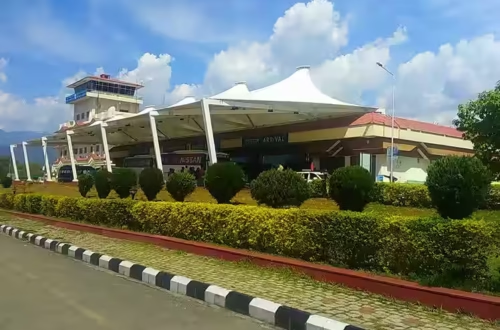
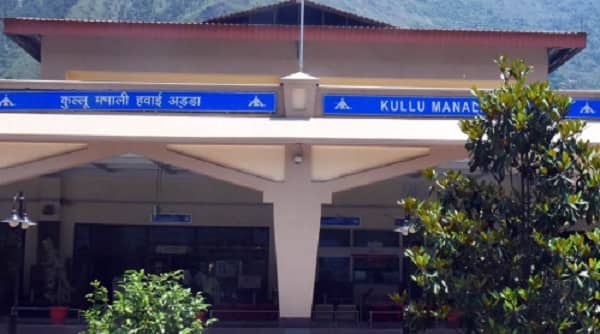
A new terminal building at Bhuntar was inaugurated in 2008 alongside the enlargement of the airport apron to accommodate two aircraft simultaneously. Before 2008, the terminal was smaller and the apron only allowed single-aircraft operations. The current terminal is compact but functional, handling check-in, security, a departure waiting area, and arrivals baggage claim. The two-aircraft apron means Bhuntar can service two ATR-class turboprops at the same time — the maximum scale currently possible given the site constraints.
The airport has no radio navigation aids — operations are entirely visual. There is no instrument landing system (ILS), no NDB (non-directional beacon), and no published instrument approach procedure in the standard sense. This restricts Bhuntar to day VFR operations only, meaning all flights must operate in acceptable visual conditions. When the valley fills with cloud or visibility drops below minimums, flights are delayed or cancelled rather than diverted to instrument approaches.
Alliance Air has been the primary operator at Kullu–Manali Airport in its modern UDAN-era operations, connecting Bhuntar to Delhi, Chandigarh, Dehradun, Amritsar, and Jaipur. The 75.5% passenger growth in 2024–25 to 29,649 passengers reflects the sharp rebound of Manali’s tourism traffic following the COVID-19 disruption years — Manali consistently ranks among India’s top five domestic mountain tourism destinations.
Kullu–Manali Airport Connectivity: Alliance Air on Multiple Routes
By Air: Alliance Air operates scheduled services from Kullu–Manali Airport to Delhi, Chandigarh, Dehradun, Amritsar, and Jaipur as of mid-2026. These five destinations represent a notably wide route network for an airport handling under 30,000 annual passengers, made possible by the UDAN scheme’s Viability Gap Funding support. Confirm current schedules and operating frequencies directly with Alliance Air before booking — hill station airports see frequent seasonal adjustments. Approximately 13 to 15 flights per month operate from KUU on all routes combined.
Weather advisory: Kullu–Manali Airport is highly weather-sensitive. Monsoon conditions (June to September) and winter snow/fog (November to February) cause frequent disruptions. Travellers with rigid itineraries — especially those catching international connections from Delhi — should plan significant buffer time or use road alternatives for the Bhuntar–Delhi sector.
By Road: The Manali–Chandigarh highway (NH-3/NH-21) is the primary road corridor. Manali is approximately 52 km north of Bhuntar — about 1.5 to 2 hours drive in normal conditions, longer when road diversions or landslides affect the highway. Kullu city is approximately 11 km south, 20 to 30 minutes by road. Shared taxis and local buses connect the airport to Kullu bus stand and onward to Manali. App-based cabs operate in the valley with variable availability during peak season.
By Rail: There is no railway station at Bhuntar or in the Kullu Valley. The nearest broad-gauge stations are Pathankot (approximately 240 km west) and Kalka (approximately 250 km south). The narrow-gauge Kangra Valley Railway terminus at Jogindernagar is approximately 90 km west. For most travellers, road from Chandigarh (approximately 280 km, 6 to 7 hours) or Delhi (approximately 520 km, 10 to 12 hours) is the surface alternative to flying.
Kullu–Manali Airport Amenities: Functional Mountain Airport Essentials
The 2008 terminal at Bhuntar provides the basics expected of a mountain regional airport: check-in counters, security screening, a waiting lounge with seating, restrooms, and basic refreshments. Prepaid taxi information is available near the terminal exit. The two-aircraft apron means the airport can appear very quiet between flight windows and then briefly busy during the short period when an aircraft is on stand.
There are no commercial lounges, no duty-free, no multi-cuisine food court, and limited retail. The spectacular valley setting — with the Beas River visible and the Himalayan ridgeline framing the entire approach — compensates in visual terms for what the terminal lacks in commercial amenity. Limited parking is available for private vehicles. Hotels in Bhuntar, Kullu, and Manali are bookable in advance; pre-arranged hotel pickup is common given the limited on-demand transport supply during peak tourism season.
FAQs: Kullu–Manali Airport
Q1. What is the IATA code for Kullu–Manali Airport?
A: The IATA code is KUU and the ICAO code is VIBR. The airport is also known as Bhuntar Airport, located 11 km from Kullu and 52 km from Manali.
Q2. Why is Kullu–Manali Airport considered challenging for pilots?
A: The airport sits in a deep valley whose surrounding peaks rise thousands of feet above the runway. Approach paths follow the valley floor visually rather than instrument approaches. There are no radio navigation aids, no night operations, and no ILS system — all operations are day VFR only.
Q3. Which airline operates from Kullu–Manali Airport?
A: Alliance Air is the primary scheduled operator as of mid-2026, serving Delhi, Chandigarh, Dehradun, Amritsar, and Jaipur under the UDAN scheme. Confirm current schedules before booking.
Q4. How far is the airport from Manali?
A: The airport at Bhuntar is approximately 52 km south of Manali — about 1.5 to 2 hours by road in normal conditions. Road disruptions during monsoon or landslide conditions can extend this significantly.
Q5. Are flights reliable at Kullu–Manali Airport year-round?
A: No. The airport is weather-dependent and operates only in day VFR conditions. Monsoon months (June–September) and winter weather (November–February) cause frequent delays and cancellations. Build significant buffer time into travel plans, especially for onward connections.