India’s newest major airport opened on Christmas Day 2025 — and not just any airport. Navi Mumbai International Airport is the first greenfield international airport to serve the Mumbai Metropolitan Region in the modern era, designed by Zaha Hadid Architects, carrying the formal name Loknete D.B. Patil International Airport after the late parliamentarian who championed the rights of project-affected farmers, and built on 1,160 hectares of reclaimed land in Ulwe, Raigad district. By April 2026 — just four months after opening — it had already become India’s ninth-busiest domestic hub. It carries IATA code NMI and ICAO code VANM, handled 6,38,394 passengers in its first four months of operations (December 2025 to March 2026), and is run by Navi Mumbai International Airport Limited (NMIAL) — an Adani Airports joint venture with 74% Adani Airport Holdings and 26% CIDCO (City and Industrial Development Corporation of Maharashtra).
Quick Overview: Navi Mumbai International Airport
| Detail | Information |
| Official Name | Loknete D.B. Patil International Airport / Navi Mumbai International Airport |
| Also Known As | NMIA; NMI Airport |
| Location | Ulwe, Raigad district, Navi Mumbai, Maharashtra |
| IATA Code | NMI |
| ICAO Code | VANM |
| Owner | CIDCO (26%) + Adani Airport Holdings (74%) |
| Operator | Navi Mumbai International Airport Limited (NMIAL) |
| Inaugurated | 8 October 2025 (PM Modi) |
| Commercial Operations | 25 December 2025 |
| Terminal | Single integrated Terminal 1 (Zaha Hadid Architects; lotus design) |
| Terminal Capacity | 20 million passengers per year (Phase 1) |
| Cargo Terminal | ~255,000 sq. ft.; 0.5 million metric tonnes/year capacity |
| Runway | 3,700 m (A380-capable; southern runway) |
| Elevation | 8 m / 26 ft AMSL |
| Coordinates | 18°59′31″N, 73°03′42″E |
| Distance from South Mumbai | ~35–43 km via Atal Setu |
| Distance from Panvel Junction | ~5–7 km |
| Distance from Vashi | ~12 km |
| Passengers (Dec 2025–Mar 2026) | 6,38,394 |
| Aircraft Movements (Dec 2025–Mar 2026) | 4,510 |
| Current Airlines | IndiGo, Air India Express, Akasa Air |
| Domestic Routes | 15+ cities including Bengaluru, Delhi, Goa, Hyderabad, Kochi, Ahmedabad, Chennai, Nagpur, Jaipur, Chandigarh, Mangaluru, Coimbatore, Guwahati, Vadodara, Lucknow |
| International Routes | Launched from May 2026 (Gulf, Southeast Asia) |
| 24/7 Operations | From February 2026 |
| Full Build-out Capacity | 90 million passengers per year |
Navi Mumbai Airport Location: Ulwe on the Atal Setu Side of the Bay
Navi Mumbai International Airport is located in Ulwe, a node within Navi Mumbai that falls administratively in Raigad district, not within Navi Mumbai’s NMMC limits. The coordinates are 18°59′31″N, 73°03′42″E, at an elevation of just 8 metres above sea level — reclaimed coastal land on the eastern shore of Thane Creek.
The airport’s location on the eastern side of the Mumbai Metropolitan Region is its defining geographic characteristic. The Atal Setu (Mumbai Trans-Harbour Link) — India’s longest sea bridge at 21.8 km — connects the airport side of the bay to South Mumbai (Sewri) in approximately 20 to 30 minutes, a travel time that was previously impossible given the bay crossing. Panvel Railway Junction is approximately 5 to 7 km from the airport, Vashi approximately 12 km, and Thane approximately 25 km. For residents of Navi Mumbai, Thane, Raigad, Kharghar, Belapur, and eastern parts of the MMR, NMIA is dramatically more accessible than the BOM terminals at Santacruz and Sahar.
The airport is named after Dinkar Balu Patil — a parliamentarian and farmer-leader who advocated for the families displaced when their land was acquired for the Navi Mumbai project. The naming honours those roots in a project built on that acquired land.
Navi Mumbai Airport Code: IATA NMI and ICAO VANM
The IATA code is NMI and the ICAO code is VANM. Use NMI on all airline booking platforms when searching for Navi Mumbai Airport flights. VANM places it in the VA western India block. The airport operates alongside CSMIA (BOM) in the Mumbai Metropolitan Region — two airports, two IATA codes, serving different geographic zones of the MMR.
Navi Mumbai Airport Terminal: Zaha Hadid’s Lotus, Phase 1 at 20 Million Capacity
Terminal 1 at NMIA is the centrepiece of the airport’s identity. Designed by Zaha Hadid Architects in a lotus-inspired form — the lotus being India’s national flower — the terminal’s sweeping white curves and biomorphic geometry make it visually distinct from any other terminal in India. The Phase 1 terminal is designed to handle 20 million passengers annually, with full build-out across four phases eventually reaching 90 million passengers per year with two additional terminals and a second runway.
The terminal integrates domestic and international operations under one roof. It has automated check-in systems and digital check-in kiosks, modern baggage handling, security screening lanes, a dedicated immigration and customs section for international flights, and a cargo terminal of approximately 255,000 square feet with a 0.5 million metric tonne annual capacity.
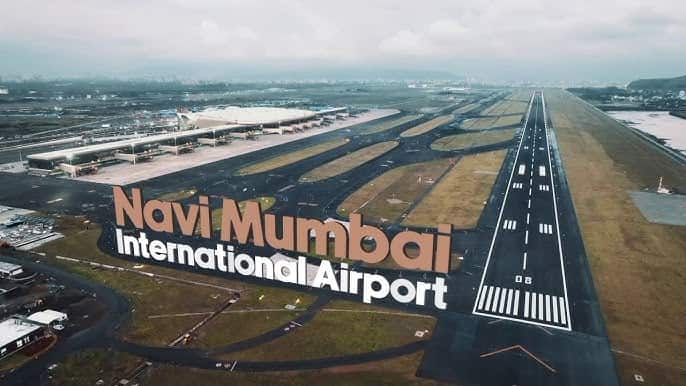
The 3,700-metre southern runway is A380-capable — long and structurally rated to handle the world’s largest commercial passenger aircraft — positioning NMIA for long-haul international routes in future phases. The airport launched with 12-hour operations (08:00 to 20:00) for the first six weeks before transitioning to round-the-clock 24/7 operations from February 2026, expanding to 34+ daily departures and accommodating early-morning and late-night international flight windows.
Three premium lounges operate within Terminal 1 — the Celebrity Lounge with spa and private suites, the Adani Silver Lounge for frequent flyers, and the Loyalty Lounge — giving NMIA a premium product from day one that many larger legacy airports took years to develop.
Navi Mumbai Airport Connectivity: Three Airlines, 15+ Domestic Cities, Gulf Launches
By Air (Domestic): IndiGo, Air India Express, and Akasa Air are the launch carriers at NMIA. IndiGo is the dominant operator with the broadest network — connecting Navi Mumbai to Bengaluru, Delhi, Goa, Hyderabad, Kochi, Ahmedabad, Chennai, Nagpur, Jaipur, Chandigarh, Mangaluru, Coimbatore, Guwahati, and Vadodara among 15+ destinations. Air India Express and Akasa Air serve key domestic corridors. IndiGo planned to scale to 79 daily departures by March 2026 including 14 international destinations — confirm current schedules before booking as the network was still expanding through mid-2026.
By Air (International): International flights launched from May 2026, targeting Gulf cities (Dubai, Sharjah, Abu Dhabi, Doha) and Southeast Asian destinations. The 3,700-metre A380-capable runway supports both short-haul international and eventual long-haul operations.
By Road: The Atal Setu (Mumbai Trans-Harbour Link) connects the airport area to South Mumbai’s Sewri end in 20 to 30 minutes — a transformational journey-time reduction compared to the pre-bridge era. Panvel Junction is approximately 5 to 7 km away. Taxis, Ola, and Uber serve the airport. NMMT buses provide budget connectivity within Navi Mumbai. NH-4B provides road access from Pune and Nashik directions.
By Rail: Targhar Railway Station is approximately 1 km from the airport. Panvel Junction — a major suburban and long-distance railway junction — is approximately 5 to 7 km away, connected to Mumbai’s CST and Western Railway via suburban trains and to Pune, Goa, and beyond via mainline trains.
By Metro (Future): Navi Mumbai Metro Line 1A and the planned Gold Line (Line 8) will eventually provide rail connectivity to the airport from both Navi Mumbai and central Mumbai. Metro connectivity was not yet operational at the airport as of mid-2026.
Navi Mumbai Airport Amenities: Premium Terminal From Day One
Terminal 1 at NMIA offers a notably high-quality passenger experience for a newly opened airport. Three lounges — Celebrity, Silver, and Loyalty — serve different passenger tiers. Food and beverage outlets, retail shops, and duty-free counters (for international departures) are operational within the terminal. Wi-Fi is available throughout. Luggage trolleys are provided at designated areas. Medical facilities are in place. Digital check-in kiosks reduce counter queues. The Zaha Hadid terminal design includes generous natural light, wide circulation spaces, and a departure hall that has drawn consistently positive passenger reactions since opening.
For international flights, immigration and customs counters are operational. Arrive 2 hours before domestic and 3 hours before international departures.
FAQs: Navi Mumbai International Airport
Q1. What is the IATA code for Navi Mumbai Airport?
The IATA code is NMI and the ICAO code is VANM. The official name is Loknete D.B. Patil International Airport. Search for NMI on any booking platform for Navi Mumbai flights.
Q2. When did Navi Mumbai Airport open?
PM Modi inaugurated the airport on 8 October 2025. Commercial passenger operations began on 25 December 2025, with IndiGo’s 6E460 from Bengaluru as the first arrival.
Q3. Which airlines and routes operate from Navi Mumbai Airport?
IndiGo, Air India Express, and Akasa Air operate 15+ domestic routes covering Bengaluru, Delhi, Goa, Hyderabad, Kochi, Ahmedabad, Chennai, Nagpur, Jaipur, Chandigarh, and more. International Gulf and Southeast Asia routes launched from May 2026. Confirm current schedules before booking.
Q4. How do I get from Navi Mumbai Airport to South Mumbai?
The Atal Setu (Mumbai Trans-Harbour Link, 21.8 km) connects the Navi Mumbai side to Sewri in South Mumbai in 20 to 30 minutes by road. Panvel Junction railway station is approximately 5 to 7 km from the airport. Taxis, Ola, and Uber serve the airport.
Q5. Who is D.B. Patil and why is the airport named after him?
Dinkar Balu Patil was a Maharashtra parliamentarian and farmer-leader who championed the rights of families whose agricultural land was acquired for the Navi Mumbai development project. Naming the airport after him honours the displaced communities on whose land the city — and the airport — was built.