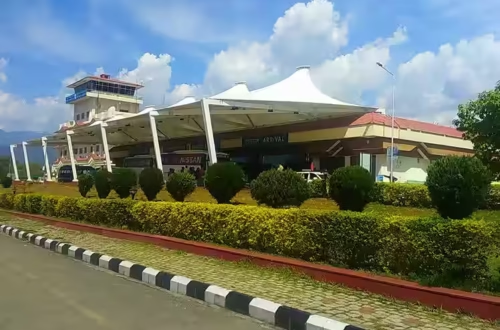
Panna is a district in Madhya Pradesh’s Bundelkhand region with a double identity that is striking in its range: the Panna diamond mines — which have been producing diamonds since at least the 16th century and are among the few alluvial diamond deposits in the world still actively producing — and the Panna Tiger Reserve, a Project Tiger site that famously lost all its tigers by 2009 through poaching and habitat loss, and then achieved one of India’s most remarkable wildlife recoveries through systematic relocation of tigers from Bandhavgarh and Kanha. Panna Airport exists on the same 106-acre site it has occupied since the AAI was assigned responsibility for it, but has been listed as non-operational since at least 2009 — when Civil Aviation Minister Praful Patel submitted a list of 32 non-operational airports to the Lok Sabha, with Panna on it. It carries no IATA code, no ICAO code, and no scheduled or unscheduled commercial passenger flights. It is maintained by AAI but remains inactive. The nearest commercial aviation is at Khajuraho Airport (HJR), approximately 50 kilometres northwest.

Quick Overview: Panna Airport
| Detail | Information |
| Airport Name | Panna Airport |
| Location | Panna, Madhya Pradesh, India |
| Airport Type | Public — Non-operational |
| IATA Code | Not Assigned |
| ICAO Code | Not Assigned |
| Owner/Operator | Airports Authority of India (AAI) |
| Land Area | 106 acres |
| Elevation | 425 m / 1,394 ft AMSL |
| Coordinates | 24°43′05″N, 80°10′54″E |
| Operational Status | Non-operational (listed as such since at least 2009) |
| Scheduled Commercial Flights | None |
| Distance from Khajuraho Airport | ~50 km northwest |
| Distance from Chhatarpur | ~40 km west |
| Distance from Satna | ~75 km east |
Panna Airport Location: Diamond District at the Vindhya-Bundelkhand Interface
Panna Airport is located in Panna city, Panna district, at coordinates 24°43′05″N, 80°10′54″E, at an elevation of 425 metres above mean sea level. The 106-acre site sits in the Panna plateau landscape — the Ken River valley that forms the ecological corridor between the Panna and Gangau plateau areas. The Ken River flows through Panna district and is the lifeline of the Panna Tiger Reserve.
Panna district’s two defining economic and ecological features give the location a dual tourism case that has never been fully served by aviation. The Panna diamond mines at Majhgawan — operated by the National Mineral Development Corporation (NMDC) — are among the world’s rarest alluvial diamond deposits. The Panna Tiger Reserve, declared a UNESCO Biosphere Reserve in 2020, has become a model conservation story — the complete loss of tigers by 2009 and the subsequent successful relocation and population recovery (the reserve now has a stable breeding tiger population of over 50 animals) is among the most studied wildlife recovery cases in South Asian conservation biology.
Khajuraho Airport (HJR) is approximately 50 kilometres northwest of Panna and 50 kilometres from the Panna Tiger Reserve’s main entry gate — making it the de facto aviation gateway to Panna despite not being in Panna district itself. This overlap creates a situation where Panna Airport’s own revival would serve a catchment that Khajuraho Airport already partially serves, reducing the economic urgency of Panna’s own airstrip development.
Panna Airport Code: No IATA, No ICAO
Panna Airport has no assigned IATA code and no assigned ICAO code. Neither designation has been formally issued — consistent with a non-operational airport that does not currently operate scheduled commercial or non-scheduled public passenger services. The AAI maintains the site but has not progressed it toward active commercial licensing. No METAR data is published. The airport does not appear in any airline booking system, pilot navigation database, or aviation information service with active operational data.
Panna Airport Terminal: A Dormant 106-Acre AAI Asset
Panna Airport occupies 106 acres of land maintained by the Airports Authority of India, but its physical infrastructure has not been developed for commercial use. In 2009, it was among 32 airports listed as non-operational in a response to a Lok Sabha question by then-Civil Aviation Minister Praful Patel. In 2007, Chief Minister Shivraj Singh Chouhan had mentioned privatising the airport — a statement that circulated without follow-through.
The historical context matters: Panna Airport appears to date to the mid-20th century period when various district-level airstrips were laid out across India under central government infrastructure programmes, often for government aviation, VIP movement, and eventual UDAN-era commercial development. Panna’s airstrip was laid out, handed to AAI, and remained dormant as larger nearby airports absorbed the region’s limited aviation demand.
The 106-acre footprint is sufficient for an UDAN-standard small airport if redeveloped. The distance from Khajuraho Airport (50 km) is within the UDAN scheme’s minimum separation threshold for new routes, meaning a revived Panna Airport could theoretically complement rather than duplicate Khajuraho’s network. However, no development project, MoU, UDAN route award, or construction timeline has been announced for Panna Airport as of mid-2026.
Panna Airport Connectivity: No Commercial Flights; Khajuraho Serves the Region
By Air: No flights of any kind operate from Panna Airport as of mid-2026. The airport is non-operational.
Nearest Commercial Airport: Khajuraho Airport (HJR, IATA: HJR, ICAO: VAKJ) at approximately 50 km northwest is the nearest commercial airport, with IndiGo serving Delhi among other domestic routes. Khajuraho Airport is also approximately 50 km from the Panna Tiger Reserve’s main gate — making it the practical aviation gateway for wildlife tourism to Panna.
By Road: Panna city is connected by road to Khajuraho (approximately 50 km west-northwest), Chhatarpur (approximately 40 km west), Satna (approximately 75 km east, a significant railway junction), and Jabalpur (approximately 200 km southeast). State highway and national highway connectivity provides surface transport access to the broader region.
By Rail: Panna does not have its own railway station with significant connectivity. Satna Junction (approximately 75 km east) is the nearest major railway station — on the Howrah-Mumbai line of the West Central Railway — with connections to Jabalpur, Allahabad, Mumbai, and other cities. Khajuraho Railway Station (approximately 50 km) has limited services.
Panna Airport Amenities: No Public Facilities; Non-Operational Site
There are no public passenger amenities at Panna Airport. The site is a dormant AAI asset with no terminal building, no check-in counters, no commercial services, and no ground infrastructure accessible to the public.
Panna town has accommodation ranging from basic guesthouses to mid-range hotels serving the tiger reserve tourism market. The Ken Gharial Sanctuary — also within Panna district — is an additional wildlife attraction. For all practical travel purposes, visitors to Panna and its tiger reserve use road transport from Khajuraho (50 km), with Khajuraho Airport (HJR) as the nearest air entry point.
FAQs: Panna Airport
Q1. Does Panna Airport have an IATA or ICAO code?
A: No. Panna Airport has no assigned IATA code and no assigned ICAO code. It is a non-operational airport maintained by AAI without active commercial aviation activity.
Q2. Why is Panna Airport non-operational?
A: Panna Airport was listed among 32 non-operational airports in a Lok Sabha submission by the Civil Aviation Minister in 2009. Limited aviation demand in the district, proximity to Khajuraho Airport (50 km) which absorbs regional aviation traffic, and absence of a funded development project have kept it dormant.
Q3. What makes Panna district notable despite having a non-operational airport?
A: Two things: the Panna diamond mines at Majhgawan (one of the world’s few remaining alluvial diamond deposits, operated by NMDC), and the Panna Tiger Reserve — a UNESCO Biosphere Reserve declared in 2020, famous for completely losing its tiger population by 2009 and then achieving a remarkable recovery through tiger relocation from other reserves.
Q4. What is the nearest commercial airport to Panna?
A: Khajuraho Airport (HJR) at approximately 50 km northwest is the nearest commercial airport, with IndiGo flights to Delhi and connectivity under the UDAN scheme. Khajuraho Airport is also approximately 50 km from the Panna Tiger Reserve’s main entry.
Q5. Is there any plan to revive Panna Airport?
A: No confirmed development project, UDAN route award, construction timeline, or MoU for Panna Airport had been publicly announced as of mid-2026. The 106-acre site remains an AAI asset in dormant status.